Hey there,
Happy New Year! I hope you had a chance to recharge over the holidays—because 2026 isn’t wasting any time. We’re only one month in, and the digital marketing landscape has already shifted in ways that feel… monumental. If 2025 was the year we all experimented with AI, January 2026 is the month it became infrastructure. We’re no longer asking “should we use AI?”—we’re asking “which AI agent do we trust with our commerce stack?”
This month’s news is dominated by one theme: agentic commerce. Google and Microsoft are racing to let AI agents shop for us. Apple and Google—yes, those rivals—are now partners. OpenAI is finally rolling out ads in ChatGPT (shocking absolutely no one who’s been paying attention). And regulators? They’re scrambling to keep up.
Let’s dig in.
1️⃣ Search Marketing
Google launches Universal Commerce Protocol (UCP) for AI-powered shopping
Google just dropped the Universal Commerce Protocol—an open standard that lets AI agents handle the entire shopping journey, from discovery to checkout. Built with Shopify, Etsy, Wayfair, Target, Walmart, Visa, Mastercard, and Stripe, UCP will power checkout experiences in AI Mode and the Gemini app. Google also launched “Business Agent” for direct retailer conversations and “Direct Offers” for exclusive AI Mode discounts.
💡 Why it matters: This isn’t just another feature—it’s a complete rewiring of how commerce works online. If AI agents become the primary shopping interface, your product data structure, SKU descriptions, and checkout flow need to be agent-readable. Traditional SEO optimized for human browsers; UCP demands optimization for AI decision-making. The brands that win here will be the ones whose structured data is immaculate and whose value propositions are machine-parseable.
🚀 Takeaway: Audit your product feeds and structured data now. If an AI agent can’t understand why your product is the best choice, you’re invisible in this new world. Start working with your dev team to implement Schema.org markup at scale.
Source: Google Blog
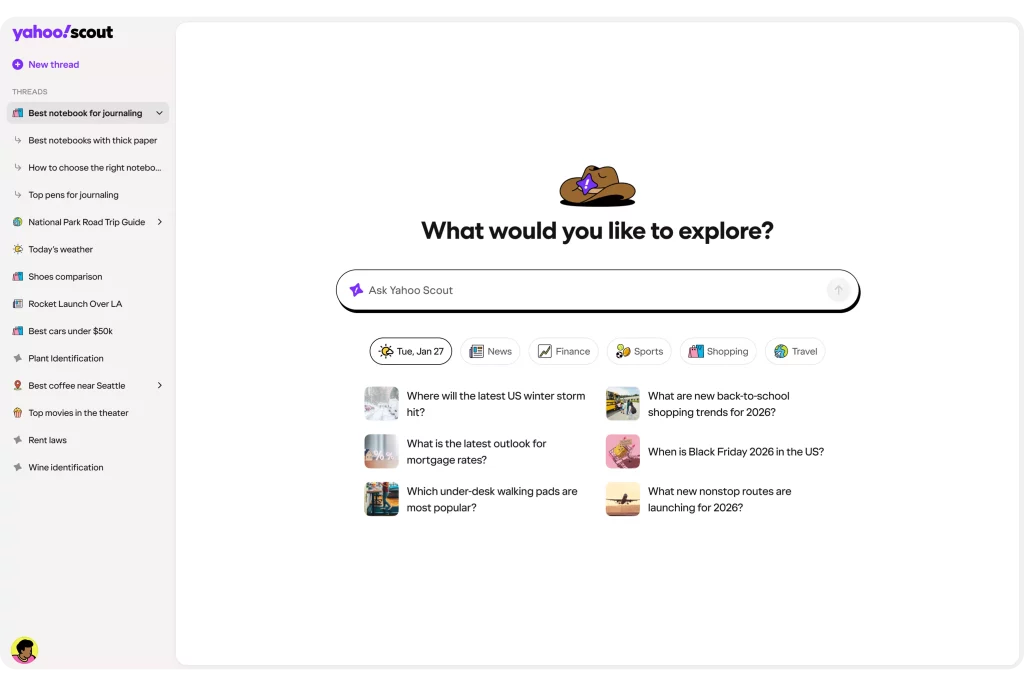
Yahoo launches Scout AI-powered answer engine with Anthropic Claude
Yahoo is back in the game. They launched Yahoo Scout, an AI-powered answer engine using Anthropic’s Claude model and Microsoft Bing’s grounding API. Scout reaches Yahoo’s 250 million monthly U.S. users across Finance, Sports, and News—and unlike some AI search experiences, it actually cites sources with inline links. The Scout Intelligence Platform extends into Yahoo Mail and Yahoo Finance for real-time analysis.
💡 Why it matters: Yahoo isn’t dead—it’s playing a very smart long game. By positioning Scout as publisher-friendly, they’re creating a differentiated value prop against Google’s increasingly closed AI ecosystem. For marketers, this is a new high-intent traffic channel. Yahoo’s audience skews older and wealthier than TikTok’s, which means higher purchasing power and potentially better conversion rates for certain verticals (finance, travel, B2B).
🚀 Takeaway: Don’t ignore Yahoo. If you’re in finance, travel, or sports, test how your brand appears in Scout results. Make sure you’re cited in authoritative sources that Yahoo’s grounding API pulls from.
Source: Yahoo Newsroom
Google integrates Gemini 3 as default model for AI Overviews and AI Mode
Google made Gemini 3 the default model for AI Overviews and AI Mode, affecting about 21% of all search queries. The update introduces a seamless transition from AI Overviews to AI Mode that overlays traditional blue links with conversational experiences. Google is also pushing hard on agentic commerce standards, letting AI agents navigate e-commerce sites and process transactions natively.
💡 Why it matters: If you’re still optimizing for “10 blue links,” you’re optimizing for a search experience that’s rapidly disappearing. Gemini 3’s reasoning is better, which means AI Overviews are more likely to synthesize answers instead of sending users to your site. Traditional organic traffic is under siege. The winners will be brands that become trusted grounding sources for AI—not just SEO-optimized pages.
🚀 Takeaway: Focus on being cited, not just ranked. Publish authoritative, quotable content that AI models trust. If you’re in e-commerce, structured data isn’t optional anymore—it’s existential.
Source: Google Blog
Apple partners with Google to power Siri with Gemini models
In a plot twist nobody saw coming (except maybe antitrust lawyers), Apple and Google announced a multi-year partnership where Apple’s next-gen Foundation Models will be built on Google’s Gemini. This will power a major Siri upgrade later in 2026, while Apple maintains its privacy standards through on-device processing. Reports suggest Apple is paying around $1 billion annually for this.
💡 Why it matters: This is wild. Apple and Google—historically bitter rivals—are now deeply intertwined. For marketers, this means Google’s AI is about to reach 2+ billion Apple device users through Siri. If you thought optimizing for Google Search was important, optimizing for Siri-powered conversational commerce just became mission-critical. Also, this deal proves that even Apple—king of “build everything in-house”—can’t compete with Google’s AI infrastructure. The AI arms race is expensive, and consolidation is inevitable.
🚀 Takeaway: Start thinking about voice commerce optimization. If Siri + Gemini becomes a primary shopping interface, your brand needs to be voice-search ready with clear, concise answers to common questions.
Source: Google Blog
Microsoft launches Copilot Checkout and Brand Agents for commerce
Not to be outdone, Microsoft rolled out Copilot Checkout—letting shoppers complete purchases directly in Copilot across Bing, MSN, and Edge. Launch partners include PayPal, Shopify, Stripe, Urban Outfitters, and Anthropologie. Shopify merchants are automatically enrolled. Microsoft also launched Brand Agents: AI chatbots trained on your product catalog to guide purchase decisions.
💡 Why it matters: Microsoft is making a serious play for conversational commerce. Copilot Checkout directly competes with Google’s UCP, and the automatic Shopify enrollment means millions of merchants are suddenly in the game whether they like it or not. Brand Agents are particularly interesting—they’re essentially custom GPTs for your brand, trained on your data. This is what “brand experience” looks like in 2026: your own AI shopping assistant.
🚀 Takeaway: If you’re on Shopify, you’re already enrolled in Copilot Checkout. Test it. See how your products surface. If you’re a mid-to-large retailer, explore Brand Agents—it’s a new way to scale personalized customer service.
Source: Microsoft Advertising Blog
2️⃣ Marketing Technology
Salesforce announces Spring ’26 Release with AI-powered sales workspace
Salesforce unveiled its Spring ’26 Release (rolling out Feb 23) with some massive updates: an AI-powered Sales Workspace combining agents, analytics, and predictive insights; “Two-Way Email” that transforms one-way blasts into AI-powered conversations (goodbye, “do not reply”); a new Agentforce Builder for creating and testing AI agents conversationally; and Agentic Enterprise Search that unifies 200+ external data sources.
💡 Why it matters: Salesforce is going all-in on agentic AI. Two-Way Email is the death of traditional email marketing as we know it—imagine every marketing email becoming a dynamic conversation where AI handles responses, qualifies leads, and schedules meetings automatically. This is what “marketing automation” was supposed to be 10 years ago. If you’re still sending static batch-and-blast emails, you’re about to look very outdated.
🚀 Takeaway: If you’re a Salesforce customer, start planning your migration to Two-Way Email. It’s a game-changer. Also, explore Agentforce Builder—being able to create custom AI agents without code is a massive unlock for marketing ops teams.
Source: Salesforce Newsroom
Treasure Data launches Marketing Super Agent multi-agent AI system
CDP vendor Treasure Data launched “Marketing Super Agent,” which they’re calling the first enterprise AI system that operates like an entire marketing department. It’s a multi-agent system with a Super Agent Orchestrator that dynamically assembles specialist agents for audience intelligence, strategy, creative, activation, and real-time optimization. It’s not a copilot—it’s a full marketing team in software form.
💡 Why it matters: This is the logical endpoint of marketing automation: AI agents that don’t just execute tasks, but orchestrate entire campaigns from strategy to creative to activation to optimization. If this works as advertised, it collapses the traditional marketing org chart. Treasure Data is repositioning the CDP from “data repository” to “autonomous marketing execution platform.” That’s a bold bet, and if they pull it off, it could disrupt the entire martech stack.
🚀 Takeaway: Watch this space. If you’re evaluating CDPs or marketing clouds, ask vendors about their multi-agent strategies. The future isn’t single-task AI—it’s orchestrated agent swarms.
Source: Business Wire
CES 2026: Omnicom, Stagwell, Amazon Ads, and Walmart unveil agentic marketing platforms
CES 2026 was the “agentic AI coming-out party.” Omnicom unveiled its Omni platform as an agentic AI operating system. Stagwell debuted “The Machine” AI marketing OS. Amazon Ads announced Full-Funnel Campaigns (launching Q1 2026) using natural language and AI-assisted creative. Walmart Connect integrated advertising into its Sparky agentic search engine and launched an agentic advertising assistant in Marty AI for brand partners.
💡 Why it matters: When holding companies, retail media networks, and Amazon all independently converge on “agentic AI as the operating layer,” you know this is the industry’s new reality. Full-Funnel Campaigns from Amazon is particularly interesting—natural language campaign setup means smaller brands can compete without needing a team of media buyers. Walmart’s Sparky integration means commerce search is now AI-mediated at one of the world’s largest retailers.
🚀 Takeaway: If you advertise on Amazon or Walmart, get ready for AI-assisted campaign management. The barrier to entry is dropping, which means competition is about to intensify. Test these new tools early to stay ahead.
Source: Amazon Ads
3️⃣ Social Media Marketing
TikTok finalizes deal to create new American entity
After years of uncertainty, TikTok officially signed a deal creating “TikTok USDS Joint Venture LLC.” Oracle, Silver Lake, and MGX will own ~45%, ByteDance retains 19.9%. Oracle will handle U.S. data storage, algorithm oversight, and content moderation. ByteDance keeps e-commerce and advertising operations. Still needs regulatory approval, but this is the closest we’ve come to a resolution.
💡 Why it matters: TikTok isn’t going anywhere. Marketers can finally stop hedging their bets and go all-in on TikTok strategy without existential risk. The new governance structure might change data policies and ad targeting capabilities (Oracle isn’t known for being as aggressive as ByteDance), so watch for any shifts in ad performance or audience targeting precision. But for now, TikTok is safe.
🚀 Takeaway: If you’ve been waiting to commit budget to TikTok “just in case,” this is your green light. Build for the long term. Invest in creator partnerships. TikTok is here to stay.
Source: NPR
YouTube CEO outlines 2026 priorities: in-app shopping, AI tools, and 200B daily Shorts views
YouTube CEO Neal Mohan published his annual letter with some big announcements: in-app YouTube Shopping (buy without leaving the platform), AI creation tools now used by 1M+ channels daily, the ability for creators to swap branded segments in existing videos, Shorts averaging 200 billion daily views, and new parental controls to set Shorts scrolling time to zero.
💡 Why it matters: YouTube is becoming a complete commerce destination, not just a top-of-funnel awareness play. In-app shopping means YouTube can finally capture transaction data and prove direct ROI, which will make YouTube ads much more attractive to performance marketers. 200 billion daily Shorts views confirms that short-form video isn’t just TikTok—YouTube is a legitimate competitor. And the branded segment swapping feature? That’s a content versioning dream for brands running influencer campaigns.
🚀 Takeaway: If you’re running YouTube campaigns, start testing in-app shopping. Optimize your product feeds for YouTube the same way you do for Google Shopping. For influencer campaigns, negotiate rights to swap branded segments post-production—massive efficiency unlock.
Source: YouTube Blog
Meta announces $6B fiber optic deal and 6.6 GW nuclear commitment for AI infrastructure
Meta signed a $6 billion deal with Corning for fiber optic cables and committed to unlocking 6.6 gigawatts of nuclear energy to power AI infrastructure. This supports Meta’s Andromeda and GEM systems that power AI-driven advertising across Facebook, Instagram, and Threads.
💡 Why it matters: Meta is making a massive bet on AI infrastructure. $6 billion for fiber optics and nuclear energy commitments signal that Meta’s AI advertising capabilities—already industry-leading—are about to get significantly better. More compute = better targeting, better creative generation, better attribution. This also tells you Meta isn’t going anywhere. They’re building for the next decade.
🚀 Takeaway: Meta’s AI ad products (Advantage+, AI creative tools) are going to keep improving. If you’re not using them yet, now’s the time to test. The platform is investing billions to make your job easier.
Source: Meta Newsroom
Instagram expands “Your Algorithm” controls globally with interest customization
Instagram rolled out “Your Algorithm” to all English-speaking users globally, letting people manually customize what they see in Reels. Users can view AI-generated summaries of their interests, add/remove topics, adjust categories, and share their algorithm profile to Stories. Instagram also asked users to pick three top interests for 2026 to guide recommendations.
💡 Why it matters: Algorithm transparency is great for users, but it’s a double-edged sword for creators and brands. If users explicitly tell Instagram they don’t want to see certain topics, your content might get filtered out even if it’s objectively good. This shifts strategy from “hack the algorithm” to “be genuinely aligned with your audience’s declared interests.” Authenticity just became non-negotiable.
🚀 Takeaway: Make sure your content aligns with the explicit interests of your target audience. If you’re in fitness, be fitness. If you’re in travel, be travel. The days of random virality are fading—intentional audience building is the new game.
Source: Social Media Today
Instagram caps hashtags at five per post and tests “Liquid Glass” UI
Instagram officially limited hashtags to five per post and is testing a “Liquid Glass” UI for iOS users with semi-transparent aesthetics. Both updates signal the end of traditional keyword-based discovery—AI-driven algorithms now handle content categorization.
💡 Why it matters: RIP hashtag stuffing. Instagram is forcing creators to be strategic instead of spammy. The five-hashtag limit means you need to choose wisely—broad enough to be discoverable, specific enough to reach your niche. And Liquid Glass UI? It’s an aesthetic shift that might influence creative direction. If Instagram is going glossy and transparent, your creative needs to feel native to that vibe.
🚀 Takeaway: Audit your hashtag strategy. Pick five that actually matter. Test combinations. Track performance. Also, keep an eye on Liquid Glass—if it rolls out widely, consider how your visual content fits the new aesthetic.
Meta rolls out Threads ads globally with Advantage+ App campaigns
Meta began global rollout of ads on Threads in late January—static carousels, video ads, and Advantage+ App campaigns. Brands without Threads profiles can use their Instagram or Facebook accounts for placement. Meta also launched Enhanced Privacy Dashboards on January 8.
💡 Why it matters: Threads is officially monetized. This opens a new text-first ad inventory for brands looking for alternatives to X and LinkedIn. Advantage+ integration means low friction for existing Meta advertisers—you can start running Threads ads without building a separate presence. This is smart. Threads already has scale; now it has a business model.
🚀 Takeaway: Test Threads ads if you’re already running Meta campaigns. The CPMs are likely lower than Instagram/Facebook in these early days. Get in before everyone else figures it out.
Source: Meta Business Blog
4️⃣ Other Notable Updates
OpenAI announces plans to test ads in ChatGPT for free and Go tiers
OpenAI confirmed it’s testing ads in ChatGPT for free-tier and ChatGPT Go ($8/month) users in the U.S. Ads will appear at the bottom of responses, clearly labeled as “sponsored,” and won’t influence ChatGPT’s answers. Plus, Pro, Business, and Enterprise subscribers remain ad-free. OpenAI is asking advertisers for $200,000 minimum commitments with a $60 CPM (vs. Google Display’s $3 CPM). CEO Sam Altman called ads “uniquely unsettling” but necessary to fund AGI research.
💡 Why it matters: Let’s be honest—we all saw this coming. OpenAI burned through billions in compute costs with no sustainable revenue model. Subscriptions alone weren’t going to cut it. What’s fascinating is the $60 CPM. That’s 20x higher than display ads, which tells you OpenAI believes conversational context is premium inventory. And they’re right. A user asking “What’s the best CRM for a 50-person sales team?” is in active purchase consideration. That’s worth way more than a banner ad on a recipe site. This is a new high-intent ad channel, and early adopters will have a massive advantage.
🚀 Takeaway: If you have budget to test, get on the waitlist for ChatGPT ads. This is a new frontier. Also, start thinking about how your brand should show up in AI-generated responses even without ads—because citations matter as much as placements.
Source: OpenAI Blog
State AI laws take effect as Trump executive order signals federal preemption
Several major state AI laws took effect January 1: California’s AI Training Data Transparency Act (requires training data summaries), California’s AI companion chatbot safety law (protects minors), and Texas’s Responsible AI Governance Act. Meanwhile, Trump’s December 2025 executive order created an AI Litigation Task Force to challenge state AI laws deemed “inconsistent with federal policy.” Colorado’s AI Act was delayed to June 30, 2026, and the FTC/Commerce Department must issue policy statements by March 2026.
💡 Why it matters: Ah, classic Trump—opposing state laws in favor of federal control. Shocking absolutely no one. The regulatory landscape is now a mess. States are passing laws, the feds are threatening to preempt them, and meanwhile marketers are stuck in the middle trying to figure out compliance. This is going to be chaos for at least the next 12 months. The real risk here is over-compliance (spending resources on state laws that get overturned) or under-compliance (ignoring state laws that don’t get overturned and getting fined).
🚀 Takeaway: Don’t ignore state AI laws just because the feds might challenge them. California and Texas have real enforcement teeth. Implement basic AI governance (documentation, risk assessments, human oversight) now. It’s good practice regardless of the legal outcome.
Source: National Law Review
EU invests €307 million in AI, robotics, and strategic digital autonomy
The European Commission launched two Horizon Europe funding calls allocating €307.3 million to AI, robotics, and digital autonomy—€221.8M for trustworthy AI services and data services, €85.5M for next-gen AI agents and industrial robotics. Applications open until April 15, 2026. This precedes the August 2, 2026 enforcement date for EU AI Act obligations on high-risk AI systems (fines up to €15M or 3% of global turnover).
💡 Why it matters: Europe is betting big on AI sovereignty. They don’t want to be dependent on U.S. (OpenAI, Google) or Chinese (Alibaba, Baidu) AI infrastructure. This funding is designed to build European AI champions. For marketers, the August 2 enforcement deadline is the real story. If you’re using AI for targeting, personalization, or automated decision-making in Europe, you need to be compliant with the EU AI Act. This isn’t theoretical—there are real fines coming.
🚀 Takeaway: If you operate in Europe and use AI in your marketing stack, audit your compliance now. You have until August 2 to get your house in order. Work with your legal team to classify which AI systems are “high-risk” and implement the required documentation and governance.
Source: European Commission
📅 Upcoming Dates to Watch (February 2026)
- Feb 14 – Valentine’s Day campaigns (if you haven’t started creative production, you’re late)
- Feb 28 – Mobile World Congress (MWC) in Barcelona—expect announcements around mobile commerce, 5G, and AI
- Early March – FTC and Commerce Department policy statements on AI regulation due (per Trump executive order)
- Mid-Feb – Likely Google Core Update (historically, Google does 2-3 core updates per quarter, and we haven’t had one yet in Q1)
So… that was January. Agentic AI, conversational commerce, ChatGPT ads, Apple + Google teaming up, TikTok saved (for now), and a regulatory mess that’ll take years to sort out.
If you take one thing away from this month, let it be this: AI agents are the new consumers. We’ve spent 20 years optimizing for human browsers. The next 20 years will be about optimizing for AI decision-makers. Structured data, authoritative content, and agent-readable product information are the new SEO.
Stay sharp. Stay curious. And if I missed anything big (or if you disagree with my takes), hit reply and let me know. I read everything.
See you next month!
📩 Want to see how Marketing Automation could work for your brand? Book a free demo with Frizbit and let’s explore it together.