February was a wild month. And I mean that in the best possible way.
I’m writing this fresh off MWC 2026 here in Barcelona — still processing everything. This year’s Mobile World Congress felt different from previous editions. The conversation has well and truly shifted from “how do we use AI?” to “how do we govern and monetize it?” Every keynote, every stand, every side conversation eventually circled back to the same tension: AI is becoming the primary interface through which consumers discover, evaluate, and buy things — and the entire marketing stack is scrambling to catch up.
Between the announcements this month, ChatGPT running its first ads, Google literally letting AI agents execute transactions on your website, Unilever committing five years to rebuilding their marketing infrastructure around AI, and Spain becoming the first country in continental Europe to ban social media for under-16s — February 2026 delivered more structural change per square centimetre than most full years.
Let’s get into it.
🔍 Search Marketing Updates
Google Previews WebMCP — AI Agents Can Now Act On Your Website, Not Just Read It
Google released an early preview of WebMCP (Web Model Context Protocol), a browser-native standard co-developed with Microsoft that lets websites publish a structured “Tool Contract” — a defined set of callable functions like bookFlight(destination, date) or addToCart(productId) — so AI agents can execute actions directly rather than guessing their way through your UI via screenshots or DOM scraping. It’s being standardized via the W3C and is already live in Chrome 146 Canary.
💡 Why it matters: SEO experts are calling this the most significant shift in technical SEO since structured data — and I think that’s an understatement. We’re not just talking about optimizing for visibility anymore. We’re talking about making your website executable by machines. An AI agent that can reliably complete a booking on Site A but fails on Site B will simply stop sending users to Site B. For travel and e-commerce brands especially, “agent-readiness” is becoming as mission-critical as page speed.
🚀 Takeaway: Sign up for Google’s WebMCP Early Preview Program now. Audit your key transactional flows — search, filter, cart, checkout — and start thinking about how to expose them as structured Tool Contracts. This is early-adopter territory, but the window to get ahead of competitors is open right now.
Source: Search Engine Land
Google Makes Links Inside AI Overviews Actually Clickable
Google VP of Search Robby Stein announced a redesigned citation experience inside AI Overviews and AI Mode: hover-based popup cards on desktop now surface article headlines, descriptions, site names, and favicons before users click, while link icons across both desktop and mobile have been redesigned to be more prominent and descriptive. It’s a direct response to publisher frustration over AI-generated summaries eating organic traffic — and also, almost certainly, a response to ongoing EU regulatory scrutiny.
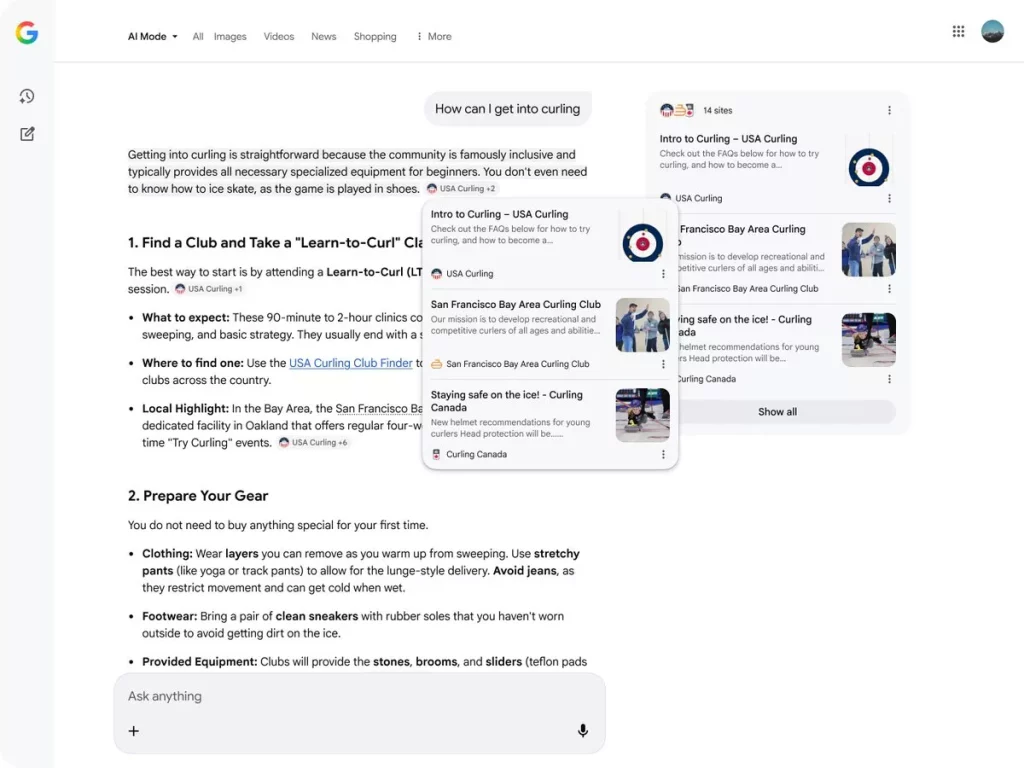
💡 Why it matters: Getting cited inside AI Overviews is now roughly as valuable as ranking on page one — and this UI change amplifies that gap further. If you’re cited, the new experience makes it easier and more compelling to click through. If you’re not cited, you’re effectively invisible to anyone engaging primarily with AI summaries. The stakes for AI-visibility SEO just went up significantly.
🚀 Takeaway: Prioritize content that is highly extractable and citation-worthy: clear structure, descriptive headings, verifiable facts, expert attribution. Think of your best content as “citation assets” — the modern equivalent of linkable assets in traditional link-building, except the goal is to be quoted by an AI, not linked by a human.
Source: Search Engine Land
Google’s First-Ever Discover-Only Core Update
Google launched its first dedicated Discover core update of 2026 — a targeted refresh that applies only to the Discover recommendation feed, not organic search rankings. The update rewards content with strong E-E-A-T signals, local relevance, and genuine topical authority, while penalizing clickbait. Initial rollout is to English-language U.S. users, with global expansion planned.
💡 Why it matters: Discover is a massive traffic driver for content-led brands, and many publishers don’t realize their Discover visibility is governed by a completely separate set of signals from their search rankings. You can rank well on Google Search and still get crushed on Discover — and vice versa.
🚀 Takeaway: Run a Discover-specific audit in Google Search Console. Filter impressions and clicks from Discover separately, identify which content types and topics over-perform, and double down on those formats. If you’ve been producing content that rides engagement metrics rather than building genuine authority, this update is a warning shot.
Source: Google Search Central Blog
🛠️ Marketing Technology Updates
Unilever Bets Five Years on AI-Mediated Commerce with Google Cloud
Unilever and Google Cloud announced a landmark five-year partnership to rebuild Unilever’s marketing and commerce infrastructure around AI — using Vertex AI and Gemini models across brand discovery, campaign measurement, and customer engagement for a portfolio that touches 3.7 billion consumers every day. The deal isn’t just a cloud migration; Unilever is explicitly preparing for a world where shoppers find and buy products through conversational AI agents, not search bars.
💡 Why it matters: When one of the world’s largest CPG companies publicly commits its entire marketing infrastructure to agentic commerce, it’s not a trend signal — it’s a seismic shift. This will set the benchmark for how CPG, retail, and e-commerce brands architect their marketing tech stacks over the next five years. The underlying message: if you’re still building for human-mediated search journeys, you’re already designing for the past.
🚀 Takeaway: Start mapping your brand’s presence in AI-mediated discovery channels. How does your brand appear when someone asks ChatGPT, Google AI Mode, or Perplexity which product to buy in your category? That answer — not your Google ranking — is increasingly what drives the first click. Audit it, then close the gaps.
Source: Unilever
Salesforce Spring ’26: AI Agents That Write Your Emails For You — Without Asking
Salesforce’s Spring ’26 release is the clearest proof yet that “agentic enterprise” is no longer a positioning statement — it’s shipping. The headline feature is Two-Way Email: an autonomous agent that conducts multi-turn conversational email campaigns without human sign-off at each step. Add the new AI Sales Workspace, a Proactive Service Command Center, and Agentforce Voice for Financial Services, and the picture is clear: AI is moving from co-pilot to autonomous operator in core marketing and sales workflows.
💡 Why it matters: The question for most marketing teams is no longer “should we use AI in our email campaigns?” — it’s “how much human oversight do we actually need, and where?” An AI that can autonomously manage a conversational email sequence compresses the role of campaign managers in ways that will start showing up in headcount decisions within 12–18 months.
🚀 Takeaway: If you’re on Salesforce, dig into the Two-Way Email and Agentforce capabilities in the Spring ’26 release notes now. Define the workflows where autonomous AI operation makes sense for your business — and, equally important, where human review gates remain non-negotiable. Getting ahead of this now puts you in a position of control rather than reaction.
Source: Salesforce
📱 Social Media Marketing Updates
ChatGPT Runs Its First Ads — And Changes the Media Planning Map Forever
This is the one that will still be talked about at the end of the year. OpenAI launched its first paid advertising product inside ChatGPT on February 9, serving sponsored content to U.S. Free and Go tier users below AI-generated responses. Launch partners include Expedia, Adobe, and Target. The initial beta requires a $200,000 minimum spend and a reported $60 CPM — enterprise territory only, for now.
OpenAI insists ads don’t influence what the AI recommends and that advertisers have zero access to user conversations. I’ll reserve judgment on how long those guardrails hold as revenue pressure grows. But the structural significance here is undeniable regardless: ChatGPT has roughly 500 million weekly users actively seeking information and recommendations. That is, by definition, the highest-intent inventory that has ever existed in digital advertising.
💡 Why it matters: This is not just a new ad format — it’s a new tier of digital advertising. Context-aware, intent-driven, and positioned at the exact moment a user is making a decision. The brands that figure out how to appear in AI answer environments — whether through paid ads or organic citation — will have a structural advantage over those still optimizing for traditional search placements.
🚀 Takeaway: Get on the waitlist or initiate conversations with your agency about ChatGPT ad access. Even if you’re not spending $200K, understanding the format, the creative requirements, and the attribution mechanics now means you’ll be ready when the minimum drops. Expedia being a launch partner is not a coincidence — travel brands should move fast on this.
Source: OpenAI
Threads Is Officially a Global Ad Platform — and It’s Already Bigger Than X
Meta completed the global rollout of Threads advertising this month. The platform now has 400 million monthly active users and 141 million daily active users — reportedly surpassing X in daily engagement. Ads support image, video, and carousel formats, are switched on by default inside Advantage+ campaigns, and run on the same AI targeting infrastructure as Facebook and Instagram.
The honest take: most brands have been sleeping on Threads. The audience is real, the competition is lower than any other Meta surface, and the integration into Advantage+ means you may already be spending there without realizing it.
💡 Why it matters: Threads is Meta’s answer to the collapse of X as a reliable brand advertising environment — and it’s working. If you’re running Meta campaigns, check your Advantage+ placements right now. You may already have Threads inventory turned on by default without a deliberate strategy for it.
🚀 Takeaway: Pull your placement breakdown in Meta Ads Manager and segment Threads performance from the rest of your inventory. Evaluate CPMs, engagement rates, and conversion contribution separately. For B2C brands, Threads’ text-forward format offers a genuinely different creative opportunity from Instagram Reels — test native-feeling conversational copy rather than repurposing visual ads.
Source: Meta
🔒 GPTs, Emerging Tech & Data & Privacy
Spain’s AEPD Publishes the EU’s First GDPR Guidance for Agentic AI
Spain’s data protection authority (AEPD) published a 71-page guidance document on agentic AI and GDPR — the first of its kind from a major EU supervisory authority. It covers prompt injection vulnerabilities, persistent memory risks, Article 22 on automated decisions, and data minimization requirements for long-running AI agents. Importantly, it doesn’t just warn — it also maps out how agentic AI can be deployed compliantly when privacy-by-default is embedded from the design stage.
💡 Why it matters: Every AI agent you’re deploying in marketing automation, CRM, or ad-tech that touches EU users now operates within a defined legal framework. Ignorance of this guidance is not a defence. The AEPD document is almost certainly the template that other EU supervisory authorities will follow as they develop their own positions on agentic AI in 2026.
🚀 Takeaway: Share this document with your legal and data teams now — especially if you’re deploying AI agents for customer segmentation, automated email, or personalization in European markets. The key question to answer is whether your AI agents satisfy Article 22 obligations on automated decision-making and whether your data retention policies are compatible with AI memory systems.
Source: AEPD (official)
Spain Announces Continental Europe’s First Social Media Ban for Under-16s
Prime Minister Sánchez used a speech at the World Governments Summit in Dubai on February 3rd to announce that Spain would ban social media access for all individuals under 16, require real age verification (not checkbox DOB fields), hold platform executives criminally liable for failing to remove illegal content, and criminalize algorithmic amplification of harmful material targeting minors. Spain then joined five other European nations in a coordinated enforcement coalition.
The law still needs to pass parliament, so enforcement timelines are uncertain. But the direction of travel across Europe is unmistakable — Australia, France, Denmark, and now Spain. The question is no longer whether this regulation reaches your market, but when.
💡 Why it matters: For any brand with youth-oriented marketing on Meta, TikTok, or Snap in European markets, this is not a theoretical future risk — it’s an active policy wave. Age verification requirements will reshape how platforms can be used for targeting, and criminal executive liability creates a very different risk calculus for platform compliance teams.
🚀 Takeaway: Begin scenario planning for youth-targeted campaigns across European markets. If under-16s are part of your addressable audience on social platforms, assess what portion of your reach is at risk if verification requirements tighten, and what channels (email, SMS, owned media) could absorb that audience with compliant consent flows.
Source: CNN
📰 News from Frizbit
This week, our CPO İlhan and I were at 4YFN / MWC 2026 here in Barcelona — and it was a fascinating few days.
If I had to summarize what’s changed from last year: in 2025, MWC was full of AI demos and “what’s possible” conversations. This year, the tone was noticeably more operational. People are asking how to deploy AI responsibly, how to measure ROI on AI infrastructure, how to govern agentic systems, and how to build customer trust in AI-mediated experiences. The hype has given way to execution pressure — which, honestly, is a healthier place to be.
The other thing worth noting: agentic commerce is emerging. The convergence of AI assistants with shopping and transaction completion — exactly what WebMCP, Google’s UCP, and the Unilever × Google Cloud partnership all point toward — dominated the conversation on the show floor. For us at Frizbit, this reinforces what we’re building toward: marketing automation that doesn’t just send messages but actively participates in the customer journey at the right moment, across the right channel, with the right context.
More updates on what we’re working on coming soon. Stay close.
📅 Upcoming in March 2026
Here are the key dates and moments to have on your radar heading into March:
- 🇧🇷 South Summit Brazil — São Paulo, March 12–14. One of Latin America’s most important startup and innovation summits. I’ll be there — if you’re attending, let’s connect.
- 🛍️ Spring/Easter Campaign Season Preparation — Easter falls in early April 2026. E-commerce brands should have campaign assets, audience segments, and automation flows ready by mid-March at the latest.
- 📊 Google Analytics 4 Annual Benchmarking — March is a good time to set your GA4 year-on-year benchmarks before the Q1 period closes. Especially relevant if you experienced Discover or AI Overviews traffic volatility in February.
- 🤖 EU AI Act High-Risk System Compliance Clock — The August 2, 2026 deadline for high-risk AI system compliance is now five months away. If you haven’t started your conformity assessment process, March is the last comfortable month to begin.
👋 Until Next Month
February 2026 was one of those months where you could feel the industry’s tectonic plates shifting in real time. ChatGPT running its first ads. Google letting AI agents execute transactions on your site. Unilever rebuilding its entire marketing stack for an agent-mediated world. Spain drawing a legal line around minors in social media (apart from also standing as an example pro-peace country no matter of what)
These aren’t isolated stories — they’re all pointing in the same direction. The interface between brands and consumers is changing, and the window to build the right infrastructure, the right content strategy, and the right compliance posture is now.
As always — if there’s a story I missed, a take I got wrong, or something you’re seeing in your own market that deserves more attention, hit reply and let me know. I read everything.
See you next month. 🚀
📩 Want to see how Marketing Automation could work for your brand? Book a free demo with Frizbit and let’s explore it together.