Writing this from Barcelona, after having a summer-like sunny days in Barcelona for the last two weeks, yesterday we had rain for the first time after some time. April ended with good conversations, useful events, and — as always — a month that moved faster than anyone planned. I caught a session on signal-based outbound: a live breakdown of a real outbound system using Clay, HeyReach, Instantly, and HubSpot together. Just a working pipeline being taken apart in front of the room. Thanks to Oriol and to all the speakers for putting that together.
If there is one word for April 2026 in digital marketing, it is agentic. Not AI-assisted, not AI-powered — genuinely agentic. Google’s search interface now dispatches multiple concurrent queries on your behalf and synthesises the results into a conversation. Salesforce renamed its Marketing Cloud after an AI agent framework. HubSpot shipped a Prospecting Agent that eliminates an entire job function at the top of the funnel. Meta opened its ad platform to ChatGPT and Claude as first-class operators. This is not the roadmap anymore. It is the product.
The world around us has been difficult. The ongoing tensions in Iran and the wider Middle East sit heavy — and I find myself, like many of us, hoping that this month is not remembered for that conflict, but for the moment it finally moved toward resolution. Marketers operate in a global economy, and a world at peace is a world where more people can build things. That matters.
🔍 Search Marketing Updates
Google AI Mode and AI Overviews Get Gemini 3 Upgrade
Google upgraded AI Overviews globally to Gemini 3 as the default model and introduced a seamless path from an AI Overview directly into a conversational AI Mode session on mobile. Under the hood, AI Mode now uses a technique called “query fan-out” — when you ask a question, it fires multiple related sub-queries simultaneously across different data sources, synthesises the results, and returns a far more layered answer than any single keyword could retrieve.
💡 Why it matters: The click-through implications are serious. AI Overviews already correlate with a 58% reduction in CTR for top-ranking pages. Now that users can go from an Overview straight into a deep conversational thread without ever visiting your page, the “organic visit” as a KPI is structurally under pressure. Google is building a search experience where your content is used but your URL is not always visited — and that distinction matters enormously for traffic-dependent businesses. On the advertising side, AI Mode impressions now appear in Google Search Console, blended with standard web data — there is no AI-specific filter yet, so your reporting will undercount this exposure for now.
🚀 Takeaway: Audit which of your top-traffic pages rely on informational intent queries — those are the pages most exposed. Begin building E-E-A-T signals (first-hand expertise, original data, unique insights) that make your content worth citing inside AI-generated answers, not just ranking above them.
Source: Google Blog
Google AI Max Declared Out of Beta, Dynamic Search Ads to Retire in September 2026
Google officially moved AI Max out of beta, citing a 7% average lift in conversions at similar CPA/ROAS when advertisers use the full feature set — with hundreds of thousands of advertisers already on the platform. The more important headline buried underneath: Dynamic Search Ads, Automatically Created Assets, and campaign-level broad match will be automatically migrated to AI Max starting September 2026. You have roughly five months to prepare, and if you do nothing, Google will handle the transition for you.
💡 Why it matters: Dynamic Search Ads have been a staple of large-catalogue advertisers for years. The forced migration to AI Max is not a minor update — it changes how creative is generated, how URLs are selected, and how audience signals are applied. “Automatic migration” sounds painless but it rarely is when it touches accounts with complex structures. The advertisers who prepare now — understanding what AI Max does differently with landing page selection and creative expansion — will have the smoother transition and the performance data to act on in Q4.
🚀 Takeaway: Map every DSA campaign in your accounts today. Audit the landing pages AI Max would autonomously crawl and the creative signals you currently control manually. Start a controlled AI Max pilot on lower-stakes campaigns now so you understand its behaviour before September’s forced migration lands on your best campaigns.
Source: Search Engine Land
Google March 2026 Core Update Completes After 12 Days
Google’s March 2026 broad core update, which started on March 27, completed on April 8 after 12 days of rollout. The pattern is by now familiar but the magnitude keeps increasing: the update routed visibility away from aggregators, OTAs, comparison engines, and review platforms toward official sources, specialist publishers, and established brands. YouTube lost 567 visibility points — roughly 30% more than Wikipedia’s record December 2025 drop — which is a signal worth pausing on. Over 55% of websites measured a ranking change.
💡 Why it matters: Google has been methodically dismantling the value proposition of middlemen for several update cycles. If your SEO strategy depends on appearing inside a comparison site, a review aggregator, or an OTA, the underlying platform that hosts your content is losing reach. The brands winning are the ones Google considers the primary source — not the ones that index, discuss, or compare primary sources. This is not a one-update phenomenon; it is a direction.
🚀 Takeaway: Check your organic traffic sources: if a material share arrives through third-party review or comparison platforms, treat that as a single point of failure that is being compressed update by update. Invest in building direct branded search volume and content depth that makes your own site the destination Google trusts.
Source: Search Engine Land
⚙️ Marketing Technology Updates
Salesforce Spring 2026: Marketing Cloud Becomes Agentforce Marketing

Salesforce’s Spring 2026 release rebrands Marketing Cloud as Agentforce Marketing — and this is not just a name change. Campaign creation now works through natural language prompts: you describe your objective, brand tone, and target, and an AI agent scaffolds the multi-channel flow. New capabilities include two-way conversational email and SMS (so a campaign can respond to a reply, not just send), unified engagement history across channels via Tableau Next, and support for up to 50 business units in one environment.
💡 Why it matters: Renaming Marketing Cloud after an AI agent framework signals that Salesforce sees the future of marketing operations as prompt-driven rather than flow-chart-driven. For the millions of enterprise teams running on this platform, the question is no longer “can we use AI in our campaigns?” but “how quickly can we restructure our workflows to assume AI handles the first draft?” Teams that approach Agentforce Marketing as a new interface layered on old processes will miss the point — and the efficiency gains — entirely.
🚀 Takeaway: If you are on Salesforce Marketing Cloud, find the Spring 2026 release notes specific to your edition and identify which Agentforce features are available in your tier. Start with one use case — campaign briefing or subject line generation — to build internal comfort before the bigger architectural shifts.
Source: Salesforce
Adobe Unveils CX Enterprise and the CX Enterprise Coworker

At Adobe Summit 2026, Adobe retired the Experience Cloud umbrella and replaced it with Adobe CX Enterprise, an AI-first platform structured around three pillars: Brand Visibility, Customer Engagement, and Content Supply Chain. GenStudio expanded from a single product into three distinct modules — for performance marketing, content marketing, and commerce media. The centrepiece announcement was CX Enterprise Coworker: a persistent, self-learning agentic AI that orchestrates multiple sub-agents and manages ongoing business objectives without a human in the loop for each task.
💡 Why it matters: Adobe is attempting to own the full creative-to-campaign loop inside one AI-orchestrated environment — a direct challenge to every specialised point solution in the enterprise MarTech stack. The Coworker concept is genuinely new: not a feature, not a chatbot, but a persistent agent that learns your brand’s operating context over time. Whether Adobe executes on this vision is an open question, but the strategic intent is clear — and it puts pressure on every standalone content, analytics, or campaign tool that sits inside an Adobe-heavy stack.
🚀 Takeaway: If your organisation uses Adobe products, map which of your current point solutions CX Enterprise Coworker is designed to replace over the next 12–18 months. Start that vendor consolidation conversation now rather than being caught mid-contract when Adobe’s integrated offering matures.
Source: Adobe Newsroom
HubSpot April 2026: An End-to-End Prospecting Agent and Reddit in Social
HubSpot’s April 2026 rollup introduced a fully autonomous Prospecting Agent that identifies in-market companies based on real-world signals — event attendance, product launches, new client signings — and then sources contact details automatically via third-party integrations. Separately, Reddit became a publishing channel inside HubSpot Social, and new unstructured engagement signals began automatically extracting budget and deal-timing insights from calls, emails, and meeting notes. Legacy CRM Card deprecation is confirmed for October 31, 2026.
💡 Why it matters: The Prospecting Agent is the starkest illustration yet that “agentic AI” in B2B sales is no longer a demo. It eliminates the manual work of identifying trigger-based outreach targets — a task that previously required either a large SDR team or significant time investment. For lean sales teams, this is a meaningful shift in what a small team can realistically cover. The Reddit publishing addition is quieter but notable: Reddit’s SEO influence has grown substantially post-Google’s deal, and having it natively in HubSpot’s social scheduler acknowledges its legitimacy as a distribution channel.
🚀 Takeaway: Audit your current top-of-funnel SDR workflow and identify which steps the Prospecting Agent could replace or augment. If you have not yet built a Reddit presence, HubSpot’s native integration is the lowest-friction moment to start — pick two or three subreddits where your target buyers are active and begin with genuine community participation before any promotional content.
Source: HubSpot
Canva Acquires Simtheory and Ortto, Pivoting from Design Tool to Marketing Platform

Canva announced dual acquisitions: Simtheory, an AI agent collaboration and management platform, and Ortto, a customer data and marketing automation company with over 11,000 customers. The Sharkey brothers, who founded both companies, will join Canva’s leadership. This is Canva’s clearest signal yet that it intends to become an end-to-end marketing operations platform — not just the design tool that 200 million people already use.
💡 Why it matters: Canva has an enormous distribution advantage: it is already inside millions of marketing teams as a trusted creative tool. Adding CDP capabilities, marketing automation, and agentic AI management behind the same login is a quiet but potentially powerful consolidation move — especially for smaller teams that cannot afford or manage multiple enterprise MarTech vendors. Ortto’s 11,000 existing customers now sit inside a product roadmap that will eventually point them toward Canva’s broader suite. Watch how this integration develops over the next 12–18 months.
🚀 Takeaway: If your team is currently on Ortto or evaluating marketing automation vendors, the Canva acquisition changes the product roadmap conversation — it is worth understanding what Canva has committed to for existing Ortto customers before making any long-term contract decisions.
Source: TechCrunch
📱 Social Media Marketing Updates
Meta Opens Its Ad Ecosystem to ChatGPT and Claude via MCP
Meta announced that its ad platform now supports the Model Context Protocol (MCP), formally opening the ecosystem to third-party AI tools — including ChatGPT and Claude — as first-class ad operators. This means external AI agents can plan, create, and manage Meta campaigns directly, without a human moving data between tools. Alongside this, Meta reported that its own business AI tools now facilitate 10 million conversations per week, up from 1 million at the start of 2026 — a 10x jump in four months.
💡 Why it matters: This is the first domino in what will almost certainly become standard across major ad platforms. When an AI agent can directly access your Meta Ads account — read performance data, generate creative, adjust bids, and launch campaigns — the human role in day-to-day campaign management shifts toward strategy, oversight, and prompt quality. The 10x growth in Meta’s own business AI conversations shows this is not a slow-adoption scenario: brands are moving fast, and the gap between those building AI-native ad workflows and those still doing things manually is widening every month.
🚀 Takeaway: Experiment with connecting Claude or ChatGPT to your Meta Ads account via MCP now — even as a read-only audit tool. Understanding how AI agents interpret your campaign structure and performance data will give you a head start on the workflow redesigns that are coming whether you choose them or not.
Source: TechCrunch
Meta Q1 2026: $56.3B in Revenue, 33% Growth, AI Creative at 8 Million Advertisers

Meta’s Q1 2026 results were exceptional by any measure: $56.31 billion in revenue, up 33% year-over-year — the fastest quarter since 2021 — driven by a 19% rise in ad impressions and a 12% increase in average price per ad. AI creative tool adoption doubled from 4 million to 8 million advertisers year-over-year, and the Value Optimization suite crossed a $20 billion annual revenue run-rate. Meta simultaneously raised its 2026 capex forecast to $125–145 billion.
💡 Why it matters: Eight million advertisers using AI creative tools means that AI-assisted ad creation on Meta is no longer an early-adopter practice — it is the majority behaviour. The advertisers not using these tools are now the exception, and they are likely paying a performance penalty in both CPMs (less competitive creative) and ROAS (less optimised delivery). The 33% revenue growth also signals that the ad market is healthy and that Meta’s AI investments are translating directly into advertiser returns — which means CPM pressure will continue to rise as more budget competes for the same inventory.
🚀 Takeaway: If you are not yet using Meta’s Advantage+ Shopping or AI creative features, benchmark your campaign performance against Meta’s reported averages. The 1.6% lift in conversion rate from the Adaptive Ranking Model and the 6% conversion lift for landing page view ads are not trivial — these are compounding advantages that manual setups are forfeiting.
Source: CNBC
TikTok Integrates Seedance 2.0 into Symphony: Video + Audio from a Single Prompt

TikTok integrated ByteDance’s Dreamina Seedance 2.0 model into its Symphony Creative Studio, making it available globally to all paid TikTok advertisers. Seedance 2.0 generates video and synchronised audio in a single pass from a text brief, image, or reference video — addressing the two main friction points in AI ad creative: inconsistent product appearance across frames, and the need to separately edit audio. The integration has been validated by safety teams and third-party red-teamers.
💡 Why it matters: Generating consistent, audio-synchronised video from a brief in a single pass collapses what used to be a multi-day production cycle into minutes. For e-commerce brands that need frequent, culturally-timed creative — new product launches, seasonal moments, trend responses — this changes the economics of being present on TikTok at scale. The brands that historically avoided TikTok because video production was expensive now have no cost excuse. The question becomes whether the creative is good, not whether you can afford to produce it.
🚀 Takeaway: Run a direct comparison test: produce one TikTok ad using your current production workflow and one using Seedance 2.0 inside Symphony Creative Studio. Compare not just the cost and time, but the creative quality and early performance signals. If the AI version performs within 80% of your manual creative, the economics of scaling TikTok creative production have fundamentally shifted for your brand.
Source: TikTok for Business
Instagram Tests Clickable Caption Links for Meta Verified Subscribers
Meta began testing direct, clickable links inside Instagram post captions — a feature that has been requested since Instagram launched more than fifteen years ago. The test is limited to Creator accounts (not Business profiles) subscribed to Meta Verified, capped at 10 links per month, and accessible only via mobile. It is an early, restricted rollout — but it signals the direction of travel clearly.
💡 Why it matters: The “link in bio” workaround has shaped Instagram marketing strategy for fifteen years. It created entire tool categories (Linktree, Later, and dozens of others) and forced a friction point between discovery and conversion that no other major social platform has maintained as stubbornly as Instagram. If caption links roll out broadly, the conversion architecture of Instagram changes — direct attribution improves, the bio link loses importance, and content strategy shifts toward embedding specific CTAs in captions rather than driving to a hub. Even at this limited stage, it is worth understanding the mechanics before it becomes standard.
🚀 Takeaway: If you are on Meta Verified, activate this test immediately and experiment with different caption link placements and CTAs. If you are not on Meta Verified, document what you would test so you can move quickly when broader availability comes — because it will.
Source: Social Media Today
LinkedIn Expands AI-Powered Conversational Search to All Users Worldwide
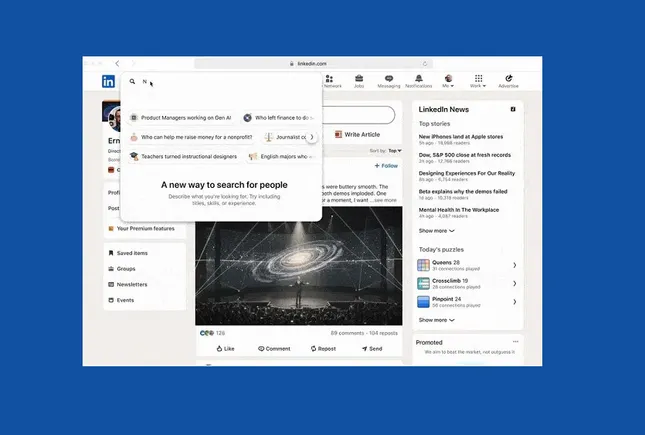
LinkedIn expanded its AI-powered conversational search — previously limited to Premium subscribers in the US — to all users globally. The tool allows natural language queries to find people, companies, jobs, and content across the platform. LinkedIn simultaneously launched Crosscheck, a platform for testing AI models before deploying them in business contexts.
💡 Why it matters: AI search on LinkedIn reshuffles discoverability for B2B content and profiles. Traditional LinkedIn optimisation — keyword-heavy headlines, skill endorsements, job-title matching — was built for exact-match search logic. Conversational search works differently: it interprets intent, weighs contextual relevance, and may surface a profile that answers a query even if it does not contain the exact searched terms. For B2B marketers whose pipeline depends on LinkedIn organic reach, this is a meaningful shift that requires rethinking content through an NLP lens rather than a keyword one.
🚀 Takeaway: Search your own company, your product category, and your target buyer’s problem statements in LinkedIn’s new conversational search. See what comes up, and whose profiles and content appear. This will tell you more about where your LinkedIn content strategy is under-optimised than any traditional keyword research tool will.
Source: Social Media Today
🔒 GPTs, Emerging Tech & Data & Privacy
Anthropic Debuts Claude Mythos Preview — and Chooses Not to Release It
Anthropic unveiled Claude Mythos Preview, a new model that autonomously identified thousands of previously unknown zero-day vulnerabilities across every major operating system and web browser using a simple prompt — and generated complete, working exploits without formal security expertise from the user. Rather than releasing Mythos publicly, Anthropic restricted access to 12 partner organisations under Project Glasswing, committing $4 million in open-source security donations and $100 million in usage credits for defensive work. The UK’s AI Safety Institute independently confirmed the model’s capabilities.
💡 Why it matters: The story here is not just what Mythos can do — it is that Anthropic built something this capable and deliberately chose not to put it in the world. That is a meaningful act of self-governance at the AI frontier, and it sets a precedent. For marketers, the practical implication is less dramatic but still real: the AI tools available to you publicly are already curated versions of what the labs have actually built. The capability gap between what is deployed and what exists is growing. From a security standpoint, every marketer managing customer data should be thinking about whether their stack is prepared for a world where finding exploits takes a simple prompt.
🚀 Takeaway: Use this as a prompt (pun intended) to audit your customer data infrastructure. If Anthropic found zero-days in every major OS, the attack surface your marketing stack touches is larger than you think. Review your data retention policies, API access controls, and third-party integrations — this month, not next quarter.
Source: Anthropic
OpenAI Launches GPT-5.5 with Agentic Coding and Deep Research
OpenAI released GPT-5.5 on April 23, with significant improvements in agentic coding, computer use, and deep research tasks. The model is designed to carry multi-step tasks through to completion — writing and debugging code, researching online, analysing data, creating documents, and operating software in sequence without requiring a human handoff between steps. Within days, OpenAI also announced GPT-5.5-Cyber, a restricted cybersecurity version, following Anthropic’s Mythos announcement earlier in the month.
💡 Why it matters: For marketers, GPT-5.5’s agentic capabilities translate into something concrete: multi-step marketing workflows — research a competitor, draft a brief, generate creative variants, pull performance data, write a report — can now run as a single automated pipeline rather than a series of manual prompts. The pace of model releases is itself a signal: OpenAI released GPT-5.4 less than two months before GPT-5.5. The AI tools available today are not the ones you will be using in six months, and building workflows that are model-agnostic will become increasingly important.
🚀 Takeaway: Identify one multi-step research or reporting task your team does weekly. Map every step, then try building it as a GPT-5.5 agent workflow. Even a partial automation — say, competitor monitoring with a weekly digest — creates immediate time savings and builds your team’s practical AI workflow muscle.
Source: TechCrunch
EU AI Act High-Risk Deadline: August 2, 2026 — Do Not Wait for the Deferral
The second political trilogue between the European Parliament, the Council of the EU, and the European Commission on April 28 ended without agreement on the “Digital Omnibus” proposal that would defer the high-risk AI compliance deadline from August 2, 2026 to December 2, 2027. A third trilogue is scheduled for May 13, but organizations are formally advised to treat August 2026 as the binding deadline. If you are using AI in employment decisions, credit scoring, lead qualification (if credit-adjacent), or education contexts, you may be operating a system that falls under Annex III high-risk categories.
💡 Why it matters: The EU AI Act is not a future regulation — it is an active one. The general provisions have been in force since August 2024. The Annex III high-risk provisions — the ones most likely to affect MarTech stacks — arrive August 2026. That is three months away. The deferral is not guaranteed, and a compliance failure after that date carries significant penalties. Many marketing teams have not audited whether their AI-driven tools — lead scoring models, targeting algorithms, personalisation engines — fall under high-risk definitions. The answer is not always obvious, and “we were waiting to see if the deadline moved” is not a compliance defence.
🚀 Takeaway: Conduct an AI inventory audit of your MarTech stack before the end of May. For each AI-powered tool, assess: does it influence decisions about individuals in employment, credit, or education contexts? If yes, consult legal on your Annex III obligations under the EU AI Act — before August, not after.
Source: EU AI Act Service Desk (European Commission) —
OpenAI and Anthropic Both Restrict Cybersecurity AI Models Within One Week

Within seven days, both OpenAI and Anthropic released powerful cybersecurity AI models — and then chose not to give either to the public. Anthropic’s Claude Mythos Preview (April 7) was restricted to 12 defensive security partners. OpenAI’s GPT-5.5-Cyber (April 30) followed the same path — notable because OpenAI had initially criticised Anthropic for being too restrictive, then arrived at exactly the same conclusion for its own model. Both labs are now self-governing at the frontier.
💡 Why it matters: When the two leading AI labs independently decide their most capable models are too dangerous to ship publicly, and then act on that conclusion, it establishes a new governance norm without any regulation requiring it. For marketers, the context is this: the AI tools you are using today are already the curated, safety-filtered version of what these companies have built. The full capability — the model that finds zero-days, that autonomously runs cyber operations — exists but is behind a firewall. The implication for trust and governance in AI-powered marketing tools is real: know what your vendors are building, even if it is not what they are selling you.
🚀 Takeaway: Review your AI vendor contracts for clauses on model updates, capability changes, and data usage. As labs develop increasingly powerful underlying models, the safe version they deploy to commercial products may shift — sometimes quietly. Know what you are agreeing to when your MarTech stack updates its AI models.
Source: TechCrunch
🧰 Tool of the Month: Claude Code
This month, the tool of the month is the one I have been using to automated the publishing process of this newsletter itself. Claude Code is Anthropic’s official CLI for Claude — it runs inside VS Code, JetBrains, and the terminal, and it operates directly on your codebase rather than just generating text snippets for you to copy. What makes it different from a standard AI coding assistant is that it can read files, write files, run terminal commands, search the web, and chain all of these together in sequence to complete a real task. That is precisely what powers this pipeline.
For marketers, the use cases extend well beyond engineering: automating report generation from raw data, building custom web scrapers for competitor monitoring, creating scheduled content pipelines, or setting up integrations between tools that do not have native connectors. If you have ever thought “I wish I could automate this,” Claude Code is probably the fastest path from that thought to a working prototype — even without formal engineering experience.
🚀 News from Frizbit
Two things worth sharing from our side this month.
First, and most exciting: we are deep in a full redesign of our dashboard UI. This will be the biggest visual and UX change in Frizbit’s history — a complete overhaul of how you interact with your campaigns, data, and automations. It is not deployed yet, but it is coming, and I think you will feel the difference the moment you log in. Stay tuned.
Second, Frizbit was officially recognised by Spain’s Ministry of Science and Innovation as an Innovative SME — the Sello PYME Innovadora. It is a meaningful certification for a company that was built around the belief that e-commerce brands of any size deserve enterprise-grade marketing automation. More at https://frizbit.com/blog/frizbit-innovative-sme-badge/
Both of these feel like the right kind of momentum to be building into the second half of 2026.

📅 Upcoming Dates
Key dates for May and June 2026 to have on your calendar:
- May 5–6 — OMR Festival, Hamburg — Europe’s largest digital marketing event
- May 7-8 — EU Startup Summit, Malta — Europe’s startup event organized by EU Startups newsletter team. I’ll be joining!
- May 11–12 — Gartner Marketing Symposium, London
- May 13 — EU AI Act Digital Omnibus third trilogue — watch for news on the August deadline
- May 20 — Google Marketing Live 2026 — Google’s annual ad product keynote (8:45 AM PT)
- May 21 — Google Marketing Live 2026 EMEA (11:00 AM BST)
- June 3 — Meta Conversations 2026, London — WhatsApp, Messenger, Instagram Direct keynote (livestream available)
- June 8–12 — Apple WWDC 2026 — iOS updates with marketing implications
- June 22–26 — Cannes Lions 2026, Cannes, France
- June 23–24 — CommerceNext Growth Show, New York
- August 2 — EU AI Act high-risk AI systems compliance deadline — this one is not on the “upcoming” radar for most teams, but it should be
👋 Sign-off
April was dense. Between Google reshaping what it means to rank, Meta opening its ad platform to AI agents, and both OpenAI and Anthropic shipping — and then locking away — their most powerful models, there was a lot to absorb. The theme underneath all of it is the same: the distance between what AI can do and what we are actually using it for in our day-to-day marketing work is still significant, and that gap is an opportunity.
I am curious what hit home for you this month. Which story surprised you most? And what are you still not sure what to do with? Hit reply — I read every response.
From Barcelona, wishing peace to everyone affected by what is happening in the Middle East and around the world. May we build a better next month.
Ata Gür
Co-Founder & CEO, Frizbit
Barcelona