Summer finally settled into Barcelona this month. It arrived late and politely, without the punishing heat that cooked much of northern Europe, so what we got was simply a normal hot June: long evenings, full terraces, and the World Cup playing on a screen in every other bar. It is a good backdrop for writing, and a fitting one too, because the biggest piece of Frizbit news this month also comes from across the Atlantic. More on that near the end.
June had two currents running in opposite directions, and the interesting part was watching them at the same time. On one side, the plumbing of the agent economy quietly got standardized. The Model Context Protocol and the Universal Commerce Protocol turned up almost everywhere: Salesforce, HubSpot, Pinterest and Shopify all shipped it into their core products, so agents can now read your data and act on it without a single custom integration. On the other side, the same month, governments started throwing switches. The US briefly forced Anthropic to shut down its two newest models, and Europe published the rulebook for how you must label AI-generated content from August. The industry is being wired together and fenced in at once.
If you want a small sign of how strange this moment is, consider that even Anthropic’s own Fable model got pulled for a few weeks and only came back yesterday, on July 1. The useful skill this month is holding both currents in your head: wire these agents into your stack quickly, and read the rules being written around them just as quickly. One without the other is how you get caught out.
🔍 Search Marketing Updates
Google adds AI search performance reports to Search Console
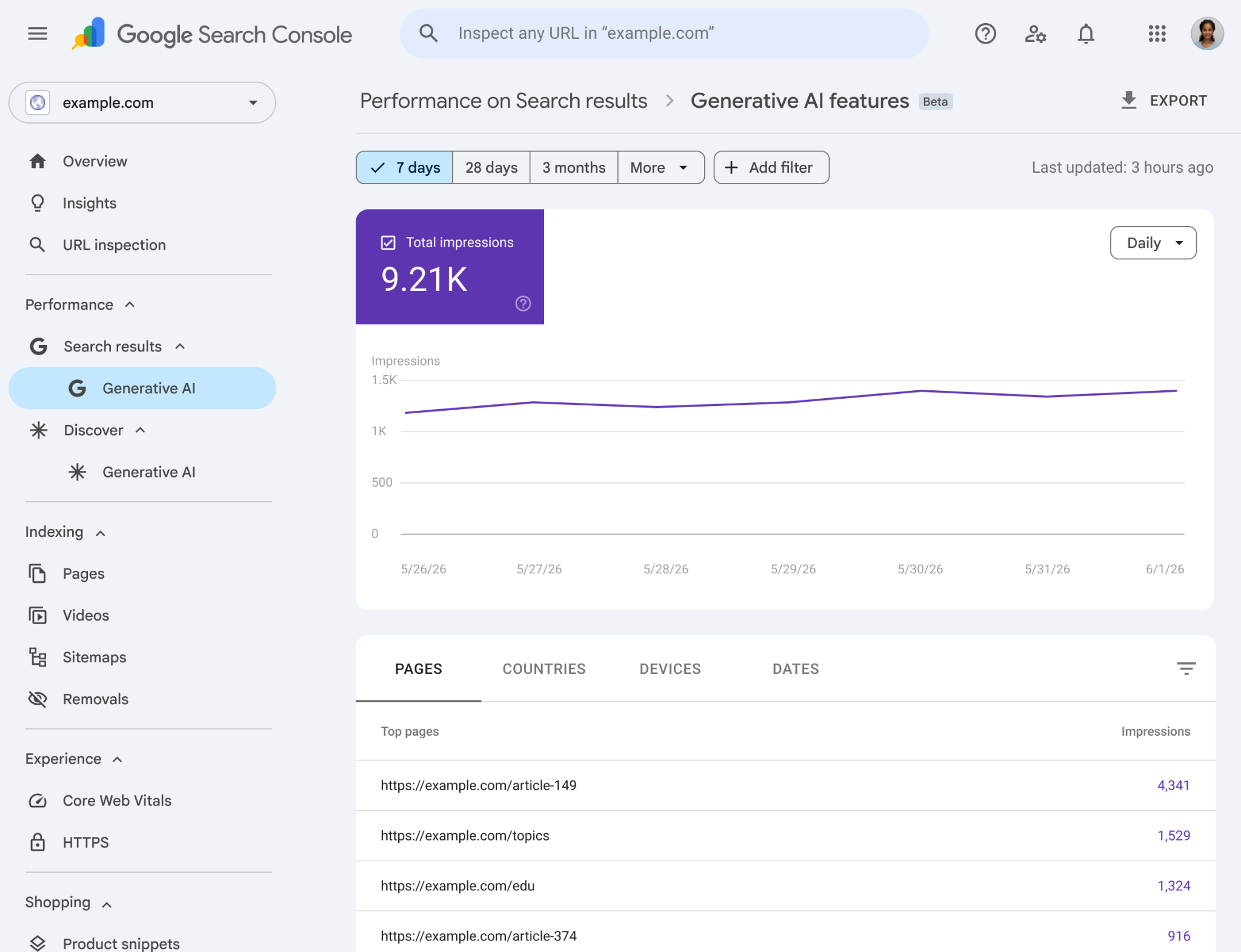
Google rolled out new Search Console reports that show how often your pages surface inside generative AI experiences, including AI Overviews, AI Mode and AI features in Discover. At launch they show impressions, pages, countries and devices, but no click or CTR data yet, and they are reaching a limited set of sites first.
💡 Why it matters: Ever since AI Mode passed a billion users, which I covered last month, the honest answer to “are we showing up in AI answers” has been a shrug. This turns that shrug into a number. It is the first native, first-party view of your presence in generative search, and it means AI visibility can finally be tracked instead of guessed at.
🚀 Takeaway: Get into the report as soon as your property has access and baseline where you appear today, by market and by page type. You cannot improve a surface you were never measuring, and the brands that start now will have months of trend data before the rest of the market wakes up.
Source: Google Search Central Blog
The May 2026 core update finished rolling out
Google confirmed its May 2026 broad core update completed on June 2, about twelve days after it began. It was the second core update of the year, and most practitioners felt it hit harder than March, with real ranking volatility across a lot of sites.
💡 Why it matters: Core updates still move organic traffic at scale, and this one landed right as AI Overviews keep skimming clicks off the top of the page. That makes diagnosis trickier than it used to be, because a traffic drop can be the update, or it can simply be the model answering the query so the click never happens.
🚀 Takeaway: Resist the urge to rewrite everything at once. Wait for the dust to settle, then segment your losses by query type and separate genuine ranking drops from clicks that AI is now absorbing. Put your effort into pages where you offer something a summary cannot copy: original data, a real point of view, first-hand experience.
Source: Search Engine Land
UK regulator forces Google to let publishers opt out of AI summaries
In what is being called a world first, the UK’s Competition and Markets Authority ordered Google to let publishers refuse permission for their content to feed AI-generated answers without being demoted in normal search. The rule covers AI Overviews, AI Mode, Gemini and Vertex AI, separates display rights from training rights, and requires the main publisher controls to be in place by December 2026.
💡 Why it matters: This is the first real crack in the take-it-or-leave-it bargain that AI search has offered content owners so far. It hands publishers a lever they have not had, and regulators in other markets will copy the template. If you produce content that AI engines quietly harvest, your negotiating position just improved.
🚀 Takeaway: Watch for these controls to appear in Search Console and decide your stance deliberately rather than by default. For most brands the smart move is still to be quotable and cited, not invisible, but now that is an actual choice you get to make.
Source: UK Competition and Markets Authority (GOV.UK)
Google widens Smart Bidding Exploration and adds a Promotion Mode

Google expanded Smart Bidding Exploration to Performance Max campaigns without product feeds and to Shopping, and launched a Promotion Mode beta that lets you temporarily loosen your ROAS target and add budget during peak periods. Google reports averages of 18% more unique converting query categories and 19% more conversions from the exploration feature, and a separate change for budget-limited campaigns kicks in automatically on August 17.
💡 Why it matters: Promotion Mode is the more useful of the two for most of us. Every peak season, performance marketers fight their own efficiency targets when they should be leaning into demand, and this finally gives you a sanctioned way to do it inside the platform instead of hacking around it.
🚀 Takeaway: Map your promotional calendar for the rest of the year now and plan where you will switch Promotion Mode on. Test it on one campaign during your next sale so you trust the behaviour before the big Q4 moments arrive.
Source: Search Engine Land
⚙️ Marketing Technology Updates
Shopify makes agentic commerce the default for every store
Shopify’s Spring ’26 Edition landed with more than 150 updates, most of them pointed at one idea: your catalog should be shoppable by AI assistants. The Universal Commerce Protocol, co-developed with Google, is now on by default on every store, so agents inside ChatGPT, Copilot and Google’s AI Mode can read your products and build carts using your own checkout rules and discounts. Shopify says AI searches powered by its structured Catalog convert at twice the rate of scraped data.
💡 Why it matters: When I first flagged UCP back in January, it read like a standards-body announcement you could safely ignore for a year. Shopify switching it on by default is what turns it real. If you sell online, your storefront is now an API that agents shop on a customer’s behalf, and that changes what “being findable” even means.
🚀 Takeaway: Treat your product feed the way you once treated your homepage. Clean titles, accurate attributes, structured data and honest availability are now the raw material an agent uses to decide whether to put you in the cart. Messy catalog, invisible store.
Source: Shopify
Salesforce launches Agentforce Marketing
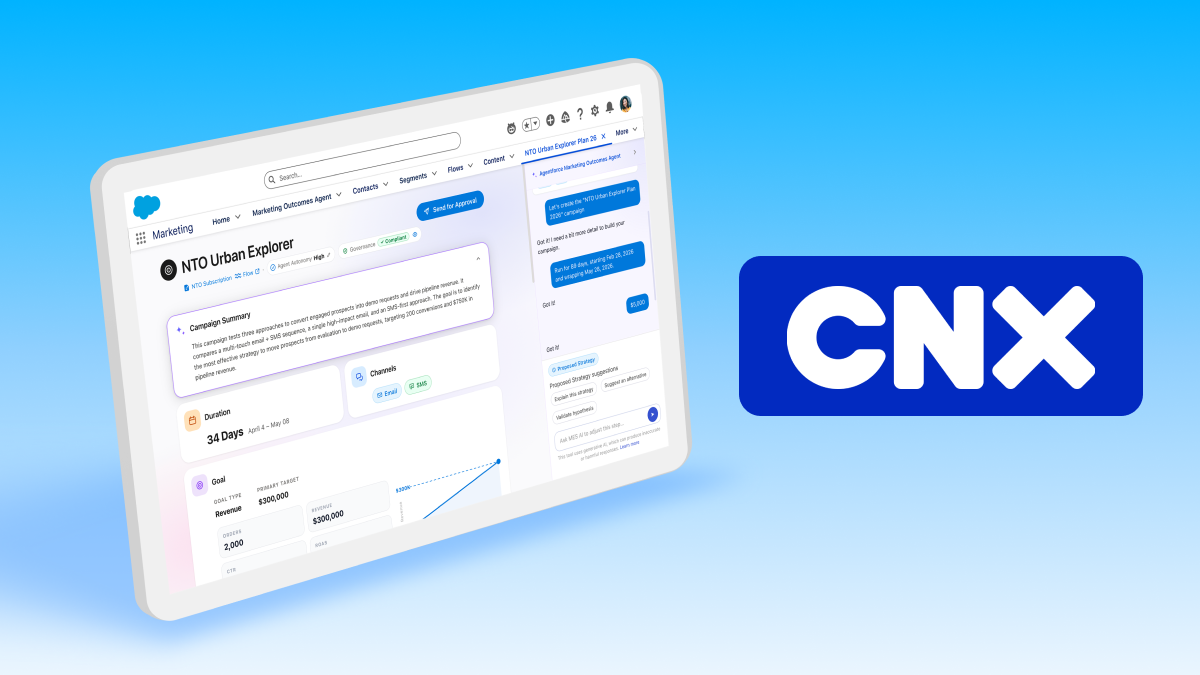
At Connections 2026, Salesforce unveiled Agentforce Marketing, a set of agents that build pipeline, generate content and run campaigns while the marketer sets the strategy. The pieces include a Marketing Goals Agent and a Content Agent, a Brand Center that stores your brand voice so every agent-made asset stays on-brand, and campaign management exposed as MCP tools so you can request a segment or launch a journey straight from Slack.
💡 Why it matters: The largest CRM on the market is now shipping agents that run campaigns end to end, and it is doing it through MCP, the same connective tissue I wrote about in February. The marketer’s job shifts from operating the tool to briefing, approving and setting guardrails the agents work inside.
🚀 Takeaway: The Brand Center is the part to take seriously. If agents are going to produce your content at volume, the quality of your documented brand voice becomes a direct input to output quality. Write it down properly, because vague brand guidelines now produce vague campaigns at scale.
Source: Salesforce
Databricks enters martech with CustomerLake, an agentic CDP
Databricks launched CustomerLake, a customer data platform built natively on its lakehouse, marking its formal move into marketing technology. Beyond the usual identity resolution and audience building, it pushes “infinity campaigns,” continuous agent-driven engagement loops meant to replace one-off campaign sends, and it arrived in private preview with names like HP, Circle K and AB InBev.
💡 Why it matters: A data-infrastructure giant walking straight into the CDP space tells you where the real fight is: the customer data layer, not the campaign tool sitting on top of it. The “always-on loop instead of a send” idea also quietly challenges the whole calendar-driven way most teams still plan lifecycle marketing.
🚀 Takeaway: If your customer data still lives in silos your campaign tool cannot reach, that gap is about to cost you more than it did. Push the unglamorous work of consolidating and cleaning your first-party data up your roadmap, because every agentic feature you will want next depends on it.
Source: Databricks
Adobe expands its Creative Agent across Photoshop and Premiere

Adobe widened its agentic creative assistant so you can describe an outcome and let the agent run multi-step production across Firefly, Photoshop, Premiere, Illustrator, InDesign and Frame.io. New skills include brand-kit generation, short-form video and storyboard-to-video, and Adobe is also surfacing these tools inside third-party assistants including ChatGPT, Claude, Copilot and Gemini.
💡 Why it matters: Creative production has been the stubborn bottleneck in the marketing workflow for years. An agent that can carry a brief through several apps to a finished asset compresses the distance between idea and campaign, and doing it inside the tools designers already trust matters more than another standalone generator.
🚀 Takeaway: Point the agent at your highest-volume, lowest-craft work first: resizing, versioning, format variants, quick social cuts. Free your actual creatives for the ideas that still need a human, and measure the hours you get back before you decide how far to push it.
Source: Adobe
HubSpot’s MCP server can now build and publish landing pages
HubSpot extended its remote MCP server so connected AI assistants can create, edit and publish landing pages, changing copy, headlines and CTAs, reordering sections, handling form embeds and hitting publish. It also broadened content analytics to cover all standalone web assets rather than only campaign-linked pages, capping one of HubSpot’s biggest shipping months.
💡 Why it matters: For the many small teams who live inside HubSpot, this removes a genuine bottleneck between “we should test a page for this” and a live page. It is also more proof that MCP is becoming the standard way your stack talks to the assistants you already use, rather than a novelty.
🚀 Takeaway: Try it on a low-stakes page first, a small campaign or an internal test, and watch what it gets right and wrong. If it produces a clean page reliably, you have bought back time; if it struggles, you have just found exactly where your templates and content model are messy.
Source: HubSpot
📱 Social Media Marketing Updates
Threads crosses 500 million monthly users
Meta announced Threads has passed 500 million monthly active users, roughly three years in, and is now close to X on daily activity. To mark it, Meta graduated Communities out of beta, added new community controls, and rolled out “Your Algo,” a setting that lets users tune their own feed.
💡 Why it matters: Threads is now big enough to treat as a real distribution channel rather than a side experiment, especially for brands and founders building in public. The user-controlled feed setting is the part worth watching, because when audiences can tune their own algorithm, pure reach games get harder and being genuinely worth following matters more.
🚀 Takeaway: If your brand or your founder has any presence on Threads, give it a proper month of consistent posting and read the engagement honestly before you judge the channel. Text-first, conversation-led content still travels here in a way it no longer does on the older networks.
Source: Meta Newsroom
Instagram opens Reels post-view ads to all advertisers

Instagram made its Reels post-view ad placement available to every advertiser globally through the existing Reels tools in Campaign Manager. The format plays an ad after an organic Reel finishes, with a five-second countdown and a skip button that returns the viewer to the original clip, and it only runs on organic Reels longer than 60 seconds.
💡 Why it matters: This is genuinely new inventory on the most-watched surface Instagram has, and new inventory always has an early window before competition bids the costs up. It rewards brands that show up and test before best-practice decks exist for it.
🚀 Takeaway: Carve out a small test budget and build a few Reels-native ads specifically for this slot, designed to earn the first two seconds after an organic clip ends. Judge it on incremental reach and cost per result, not on borrowed benchmarks from feed placements.
Source: Social Media Today
Pinterest ships AI ad tools and an “Ask Pinterest” shopping app
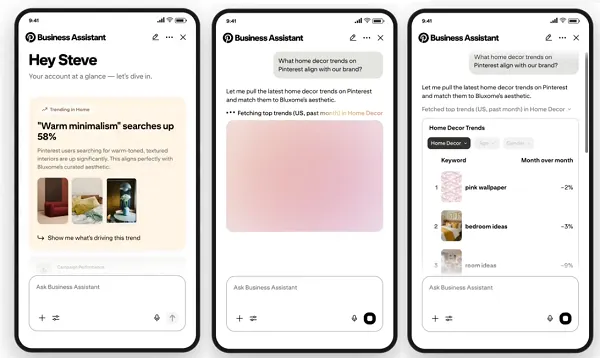
Timed to Cannes Lions, Pinterest introduced a set of AI advertiser tools, including a Business Assistant inside Ads Manager in closed US beta, a Pinterest MCP server, and new Performance+ creative features. It also unveiled a standalone “Ask Pinterest” app to test conversational, agentic shopping.
💡 Why it matters: Pinterest is high-intent, shopping-led traffic that a lot of ecommerce brands quietly underrate. An MCP server plus an agentic shopping app puts it in the same race as the giants, and for the right catalog it is often a cheaper, calmer place to convert than the feed.
🚀 Takeaway: If your products are visual and considered, home, fashion, beauty, food, reassess Pinterest this quarter with fresh eyes. Get your catalog and Performance+ setup in order now so you are ready as the agentic shopping features open up.
Source: Social Media Today
Snapchat rolls out AI-powered ad creation
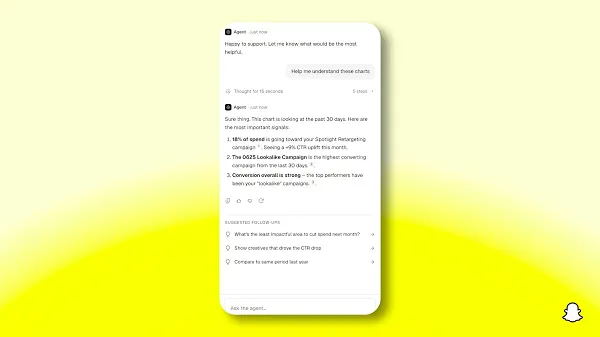
Snapchat launched a set of AI advertising features led by a chatbot inside Ads Manager that lets advertisers describe a goal and get guided campaign setup and recommendations. It also upgraded Dynamic Product Ads with new recommendation models and added creative tools like smart upscaling and image-to-video, with a creator-matching network promised for later this year.
💡 Why it matters: Every platform is racing to lower the skill floor for running ads, and Snapchat needs that more than most to stay in the consideration set. For brands with a genuinely young audience, easier setup plus stronger product ads makes it cheaper to test the channel without a dedicated buyer.
🚀 Takeaway: If your customers skew under 25, run a small structured test here rather than writing Snapchat off. Lean on the new Dynamic Product Ads and the AI setup to keep the effort low, and hold it to the same cost-per-result bar as your other channels.
Source: Social Media Today
YouTube reworks the Shorts player: dislikes out, 2x speed in

YouTube overhauled the Shorts player, removing the dislike button, swapping the like thumb for a heart, and adding a tap-and-hold 2x playback speed. A new Clear Screen mode hides the interface, and feedback is being steered toward “Not Interested” and “Don’t recommend this channel.” Dislike counts stop updating for Shorts in Studio, while long-form videos keep theirs.
💡 Why it matters: Changing the feedback signals and letting people watch at double speed both change the physics of the most-watched short-video surface there is. Faster consumption and softer negative signals mean the opening beat of a branded Short carries even more weight than before.
🚀 Takeaway: Rework your Shorts to land the hook in the first two seconds and stay legible at 2x speed, with the key message visible even when the interface is hidden. Assume less patience and less explicit negative feedback, and let watch-through, not likes, be your read on what is working.
Source: TechCrunch
🔒 GPTs, Emerging Tech & Data & Privacy
Anthropic releases Claude Fable 5 and Claude Mythos 5

Anthropic shipped Claude Fable 5, its most capable widely available model, alongside the stronger Claude Mythos 5, which it held back to vetted partners over heightened cyber and bio risk. Fable 5 posts state-of-the-art results across coding, vision and research, ships with a 1M-token context window, falls back to Opus 4.8 when safety classifiers trigger, and costs less than half the earlier Mythos Preview price.
💡 Why it matters: This is the model now powering the assistants marketers touch every day. Back in April, Anthropic showed Mythos and pointedly chose not to release it, and last month I reported it was only weeks away. In June it arrived. A big capability jump at half the price means the cost of automating content, research and analysis has dropped again.
🚀 Takeaway: Do not hard-wire your workflows to one model’s quirks. The leaders keep leapfrogging each other on a short clock, so build your AI processes, for content, support or analysis, so you can swap the model underneath as prices fall and capabilities jump. This month proved again how fast that happens.
Source: Anthropic
OpenAI previews the GPT-5.6 family, led by Sol
OpenAI opened a limited preview of GPT-5.6, a three-model family: the flagship Sol, the balanced Terra and the low-cost Luna. Sol is OpenAI’s strongest model yet, with gains in coding, biology and cybersecurity, while Terra roughly matches GPT-5.5 at half the cost. Because of cybersecurity concerns, OpenAI first opened access to only about 20 government-approved partners.
💡 Why it matters: ChatGPT is the default AI surface for hundreds of millions of people, many of whom use it to research brands and products, so every model jump changes how confidently it talks about you. Terra at half the cost is the quieter story: it reshapes what you can afford to run at volume.
🚀 Takeaway: Run your brand, your key products and your own name through ChatGPT again once GPT-5.6 is widely live, and note what it now gets right or wrong. When the default model shifts, so does what a large slice of your audience is told about you, and the fix is almost always improving the public sources it draws on.
Source: OpenAI
The US government briefly switched off the frontier

Here is the other side of that coin. In mid-June the US Commerce Department forced Anthropic to shut down Fable 5 and Mythos 5 over fears the models could accelerate cyberattacks, then partially reversed course on June 26, allowing Mythos 5 to reach more than 100 vetted US institutions. OpenAI separately confirmed it had restricted a powerful model at the government’s request, hinting at an emerging licensing regime for the most capable AI.
💡 Why it matters: For the first time, governments are deciding who gets to use the most capable models, and a model your team relied on can now be switched off by policy rather than pricing. That is a new kind of dependency risk sitting under the whole AI stack.
🚀 Takeaway: Keep at least one credible alternative model wired into anything business-critical, and know how you would fail over if your primary provider suddenly went dark. The teams that treated multi-model flexibility as good hygiene just found out why it matters.
Source: CNBC
Europe publishes its rulebook for labelling AI-generated content
The European Commission released a Code of Practice to help providers and deployers meet the EU AI Act’s Article 50 transparency duties, which start applying on August 2. It sets out how to machine-mark AI-generated content and how professional users should clearly label deepfakes and AI-generated text on matters of public interest.
💡 Why it matters: Back in April I told you not to sit around waiting for the AI Act’s high-risk deadline to slip, and then last month the simplification package did push some high-risk obligations out to 2027. The catch is that the August 2 transparency deadline did not move, and it is the part that touches everyday marketing: AI-made ad creative, copy and social content.
🚀 Takeaway: If you use AI to generate reader-facing content in the EU, agree a clear internal labelling standard with your legal or DPO before August, using this Code as the template. Being early and transparent here is cheap; getting it wrong once the rule is live is not.
Source: European Commission (Shaping Europe’s digital future)
Microsoft unveils in-house MAI models to cut its OpenAI reliance
At Build, Microsoft launched its own MAI models, led by the coding model MAI-Code-1-Flash and the reasoning model MAI-Thinking-1, as it works to depend less on OpenAI. Microsoft says MAI-Code-1-Flash, trained on GitHub Copilot production workflows, solves problems using up to 60% fewer tokens, and the models are rolling out inside Copilot in Visual Studio Code.
💡 Why it matters: Microsoft building its own models cracks the OpenAI-only assumption inside one of the biggest software surfaces on earth. For the rest of us that points toward cheaper and more varied AI options quietly appearing inside the tools we already pay for, and more competition at the model layer is good for prices.
🚀 Takeaway: When your vendors add their own models, do not just accept the default. Compare cost and quality on your actual use cases, because “fewer tokens for the same result” turns directly into margin once you are running AI at any real scale.
Source: CNBC
🧰 Tool of the Month: Profound
With Google now reporting AI search presence and a billion people using AI Mode, the obvious question is how your brand actually shows up when someone asks an assistant instead of typing a query. Profound is built for exactly that: it tracks how you appear across ChatGPT, AI Overviews, Perplexity and the rest, which prompts surface you, what they say, and where competitors edge you out. I started paying attention to this category after too many conversations where a founder assumed the AI answer about their brand was fine and it very much was not. Google’s new Search Console report is a great free starting point, but a dedicated tool like this fills in the surfaces Google will never show you. Whatever you pick, the takeaway is the same: your reputation is now partly written by models, and you should at least be reading what they say.
🚀 News from Frizbit
Two pieces of Frizbit news this month, and I am genuinely happy about both. First, we finally shipped our fully renewed dashboard, and it is now live for every client. It brings interactive analytics and reporting into one place: the full conversion funnel, subscriber health, and a clear view of the revenue Frizbit is actually generating for your store. We built it because “trust us, it is working” is not good enough. You should be able to see the impact at a glance, and now you can.
Second, and this is the one across the Atlantic I teased at the top: after months of proof of concept and contract review, we have signed AeroMexico. They are our first airline client in North America, and getting an airline of that size over the line is a real milestone for us. I cannot say much more yet, but I can finally say the name, and I am hopeful it is the first of several.
📅 Upcoming Dates
- July 2 to 3: TECHSPO Tokyo (Internet, AdTech and MarTech expo), Tokyo
- July 8 to 10: ANA Digital and Social Media Conference, Los Angeles (streaming, commerce, AI, creator marketing)
- July 16: DigiMarCon North Asia, Shanghai
- July 19: MMA CMO and CEO Summit, Santa Barbara
- July 28: Creator Economy Live East, New York (influencer and creator partnerships)
- July: Google Gemini 3.5 Pro expected to reach general availability after slipping from June
- July: TikTok’s new Violation Points system and revised TikTok Shop Store Rating take effect for sellers and creators
- August 2: EU AI Act Article 50 transparency obligations take effect (AI systems must disclose they are AI, AI-generated content must be labelled)
- Retail note: Amazon moved Prime Day to June 23 to 26 this year, so July attention shifts to back-to-school demand
👋 Sign-off
June was the month the agent economy grew up a little in both directions at once. The standards that let agents plug into everything went mainstream, and the first real rules about who can run the most powerful models and how you must label their output showed up in the same few weeks. Neither current is going to reverse. The teams that do well from here will move fast on the first while staying honest about the second.
As always, tell me what landed hardest for you this month, and what I missed. Hit reply, I read every one.
Until next month,
Ata
Co-Founder & CEO, Frizbit, Barcelona
📩 Want to see how you can recover your lost sales at your online business through Marketing Automation? Book a free demo with Frizbit and let’s explore it together.