July gave us a strange split screen. On one side, Spain beat Argentina in the World Cup final and the celebrations ran through the streets here for days, a second star and the first time any country has held the men’s and women’s titles at the same time. On the other, large parts of Europe spent the month fighting wildfires. Barcelona carried both moods at once: euphoric one week, uneasy the next, hot and humid throughout, and slowly emptying as August approached. If you are reading this from the northern hemisphere, you are probably already half out the door. Good. Take the break properly.
On July 9 I spent the morning at Tech Spirit Travel at Palau Macaya, a half day on where travel technology is heading. The framing that stuck with me was AI described as the new operating system of travel, not a feature bolted onto booking flows. Still doubts emerge on how OTA’s will evolve, while transactions will be moving to MCP’s. Whether or not you sell trips, that is the right way to read most of what happened last month.
Because July had one clear story, and it was not a product launch. It was the month the platforms started drawing lines around AI-generated content. Google attached provenance labels to ads. Meta did the same and then withdrew a feature that let people run AI edits on other people’s photos. YouTube published where the monetisation line sits. Snapchat quietly stopped recommending fully synthetic video at all. Four companies, four different mechanisms, one direction of travel. As I covered last month, Europe published the rulebook for labelling AI-generated content in June. July is when the platforms started building to it, and they are not waiting for the deadline.
🔍 Search Marketing Updates
Google introduces new AI labels for Ads

Google added a “How this ad was made” section inside My Ad Center, reachable from the three-dot menu on ads across Search, YouTube and Discover. Ads built with Google’s own generative tools get the disclosure applied automatically, while advertisers using outside AI tools get a control to flag it themselves. In some markets, local rules will push the label onto the ad unit rather than leaving it tucked inside My Ad Center.
💡 Why it matters: The interesting part is not the label, it is the asymmetry. Google’s own tools disclose automatically, third-party tools rely on you volunteering. That is a quiet nudge toward keeping creative production inside Google’s stack, where the compliance work is done for you.
🚀 Takeaway: Sort your live creative into three buckets: made with Google’s tools, made with outside AI, made by humans. For the middle bucket, write down your disclosure policy now, before a market with mandatory on-ad labelling decides it for you.
Source: Google Ads & Commerce Blog
Google’s AI search is rapidly becoming the default

Similarweb’s 2026 generative AI landscape report found AI Overviews now appear on 43% of Google searches, up from 15% a year earlier. AI Mode visits climbed from 126 million in June 2025 to 279 million in May 2026, and average query length keeps growing as people write the way they talk. The report’s conclusion is blunt: Google is turning from a gateway to the open web into a destination that answers in place.
💡 Why it matters: Tripling AI Overview coverage in twelve months resets the arithmetic behind every organic forecast written before this year. If your model still assumes a click follows a ranking, it is wrong for close to half of all searches, and that half is growing. The longer queries matter too, because they are the comparison questions that used to send qualified traffic to category and guide pages.
🚀 Takeaway: Split your organic reporting into queries that trigger an AI Overview and queries that do not, then track them as two channels with different goals: citations and brand mentions for the first, clicks for the second. Blending them hides the trend until it is too late to react.
Source: TechCrunch
AI Max arrives in Google Standard Shopping campaigns
Google began rolling AI Max capabilities into Standard Shopping, the surface that had stayed relatively manual while Performance Max absorbed everything else. Shopping ads can now be matched to conversational long-tail queries, ad copy is generated from Merchant Center feed attributes such as materials and fit, and Final URL Expansion can route traffic to a page Google selects rather than the product URL. Brand exclusions, asset controls and a Final URL Expansion off-switch all remain.
💡 Why it matters: As I flagged back in April, AI Max came out of beta and Dynamic Search Ads were put on a retirement schedule. Standard Shopping was the last serious refuge for advertisers who wanted deterministic control over which query hits which product page. Losing that does not have to be bad, but it moves your leverage: campaign structure matters less, and the quality of your product feed matters more than it ever has.
🚀 Takeaway: Before you let Final URL Expansion loose, run one week with it off and audit what Google would have chosen. Then go and fix your feed attributes, because generated ad copy is only as good as the materials, fit and dimension fields you have been ignoring.
Source: Search Engine Land
Only 15% of ChatGPT categories have a clear brand leader
Semrush analysed 1,094 US categories inside ChatGPT and found that just 15.2% had a clear owner, defined as a brand appearing in at least four of five buyer prompts with a five-point lead over the runner-up. More than half of categories had no leader at all. Popular topics were even less settled at 11.3%, despite carrying 98% of AI search volume. The predictive part is the surprise: organic traffic and Authority Score performed close to a coin flip, while branded search volume was the only signal with real statistical weight.
💡 Why it matters: This is the most encouraging AI visibility data I have seen all year, and it says something uncomfortable about how most teams are approaching it. The categories are not locked. But the lever that moves them is brand demand rather than backlinks, which means the budget that wins AI visibility sits with brand and PR, not technical SEO. Most companies have that backwards.
🚀 Takeaway: Run your five most commercially important buyer questions through ChatGPT monthly and record which brands appear. If nobody owns your category yet, that is your window, and the fastest way through it is anything that grows branded search: partnerships, podcasts, earned coverage, a founder who posts.
Source: Search Engine Land
⚙️ Marketing Technology Updates
OpenAI launches ChatGPT Work

OpenAI released ChatGPT Work, an agent that takes an outcome rather than a prompt, pulls context from your connected apps and files, breaks the job into steps and then runs for hours without supervision. It produces finished documents, spreadsheets, presentations, reports and websites, and ships with a directory of more than 1,400 connectable apps you can pull in with an @-mention.
💡 Why it matters: The model is not the moat here, the connector directory is. Whichever agent reaches your CRM, analytics and ad platforms first becomes the default place work starts, and defaults are hard to dislodge once habits form around them. Marketing produces an enormous volume of intermediate work product, the briefs and decks and competitive sweeps nobody enjoys, and that is exactly the surface this targets.
🚀 Takeaway: Evaluate this on integrations, not writing quality. List the five systems where your marketing data actually lives, check which agent connects to all five today, and pilot that one on a job you currently outsource or postpone.
Source: BNN Bloomberg
Criteo attracts a Vista Equity-backed takeover offer
Vista Equity Partners and Quinti Capital submitted a joint takeover bid for Criteo, the French commerce media and retargeting company, at a premium of more than 50% over its recent share price. Criteo had not publicly responded when the bid was reported. The company has explored a sale several times over the years without ever closing one, including talks with retail media firm Skai.
💡 Why it matters: Criteo is the company most e-commerce marketers still associate with retargeting, and a private equity take-private usually points toward margin discipline rather than product investment. That is not automatically bad, but it does change what you should expect from the roadmap over the next two years. It also says something about how the market now values classic retargeting in a world where the platforms have absorbed most of that function into their own automation.
🚀 Takeaway: If Criteo carries meaningful spend for you, ask your rep two specific questions this quarter: what happens to the product roadmap under new ownership, and what your exit path looks like if support quality slips. Get the answers in writing before renewal season.
Source: Bloomberg
StackAdapt rethinks the DSP for a post-dashboard world
StackAdapt launched Ivy Studio, a hub where marketers describe the outcome they want in plain language and AI agents grounded in campaign, audience, creative and performance data surface the context and recommend the next move. Planning, forecasting, analysis, optimisation and execution sit in one place instead of spread across separate dashboards, with the marketer keeping approval. StackAdapt says its own staff already run more than 15,000 AI-assisted workflows a week on the underlying engine.
💡 Why it matters: Plenty of vendors bolted a chat box onto a dashboard this year. The claim here is more interesting: that the dashboard itself is the legacy artefact. If that holds, the skill a media team values shifts from knowing where every setting lives to knowing precisely what to ask for and how to spot a wrong answer. That is a different hiring profile.
🚀 Takeaway: Test the failure mode, not the happy path. Give any agentic platform a deliberately ambiguous brief and see whether it asks a clarifying question or confidently does the wrong thing. The second behaviour is the expensive one, and you want to find it during a pilot.
Source: MarTech
Claude Cowork arrives on web and mobile

Anthropic extended Claude Cowork from a desktop-only agent to web and mobile in beta, starting with Max subscribers. Tasks started on a laptop keep running after you close the machine and can be reviewed from a phone, and scheduled work runs even when none of your devices are online. Anthropic’s own usage data shows most Cowork users are knowledge workers who never open a terminal, not developers.
💡 Why it matters: The detail that changes behaviour is the one that sounds least impressive: the work survives a closed laptop. Agents that require you to sit and watch are really just faster tools, and you delegate accordingly. Agents that run overnight get handed the long, boring jobs you would otherwise never start, which is where most of the actual time saving in marketing lives.
🚀 Takeaway: Make a list of the recurring jobs you keep postponing because they take three hours of nobody’s favourite work: competitor pricing sweeps, ad library reviews, monthly reporting pulls. Schedule one of them and judge the output on a Monday morning rather than watching it run.
Source: Anthropic
📱 Social Media Marketing Updates
Meta introduces Muse Image

Meta Superintelligence Labs shipped Muse Image, Meta’s first in-house image generation model, after years of leaning on outside models. It reasons through a brief before generating, so it can plan a layout, blend several photos and render legible text inside an image. It is free inside Meta AI, live in Instagram Stories effects and in WhatsApp in limited markets, and Meta says advertisers will reach it through Advantage+ creative within weeks.
💡 Why it matters: Owning the model lets Meta wire generation directly into the ad auction instead of licensing it at the edges. Once Advantage+ can spin up on-brand variations at effectively no marginal cost, creative volume stops being a budget constraint and becomes a governance problem: who approves what, and how do you stop a thousand generated variants drifting away from the brand? That is a harder question than “can we make more ads”.
🚀 Takeaway: Write your brand guardrails as instructions a model can follow, not a PDF for humans. Specify what generation gets wrong first: product colour accuracy, text on packaging, model diversity, and what your product must never be shown doing.
Source: Meta Newsroom
YouTube clarifies where AI content can still be monetised
YouTube spelled out where the monetisation line sits for AI-assisted content. Videos that add original commentary, research, storytelling or a distinct human point of view stay fully monetisable. Content assembled at volume from generic templates, with no original perspective, does not. The clarification arrived alongside updated guidance on upsetting and shocking content.
💡 Why it matters: The test is not whether AI touched the video, it is whether a human added something. That is a more workable standard than a blanket ban and a harder one to game, because it is a judgement about contribution rather than a detectable technical signal. For brands running volume video programmes, there is now a published standard to design against instead of guessing at how enforcement will land.
🚀 Takeaway: For every video in your pipeline, name the specific human contribution in one sentence before it gets produced. If you cannot finish that sentence without saying “we used a template”, you have found the videos that will stop earning.
Source: TechCrunch
Meta updates its disclosure tags for AI-generated ads
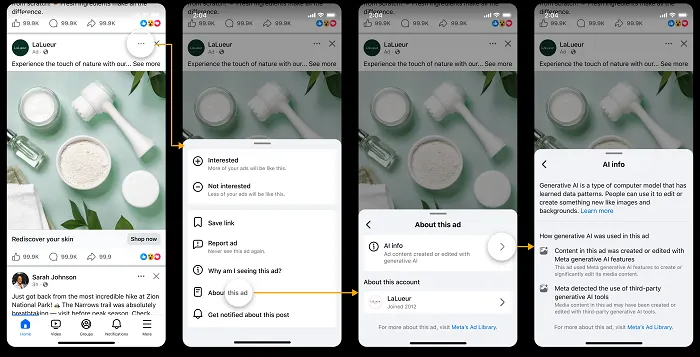
Meta changed how Facebook and Instagram ads containing AI-generated content are labelled, with the disclosure now sitting in the “About this ad” panel behind the three-dot menu. Labels apply automatically when advertisers use Meta features such as Background Generation, Image Generation or Add Animation to create or significantly edit an asset. Meta also uses C2PA and comparable detection to catch ads made with outside tools like Photoshop or DALL-E.
💡 Why it matters: This is the part most teams will get caught by. Detection runs on provenance signals embedded in the file itself, which means the label follows the asset even when it was never near a Meta tool. Product photography that someone cleaned up with generative fill eighteen months ago can inherit a tag nobody on your team chose, on an ad nobody thought of as AI-generated.
🚀 Takeaway: Run a provenance audit on your creative library, not just your new work. Find out which archived assets carry C2PA data, and decide whether you are comfortable with them being labelled before they get served at scale.
Source: Social Media Today
Snapchat stops recommending fully AI-generated Spotlight videos
Snap changed its Spotlight recommendation system so that fully AI-generated videos are no longer eligible to be recommended. Clips that use Snap’s own AI tools to enhance or edit human-made footage stay eligible, and transparency indicators still tell viewers when AI was involved. Snap framed it as keeping Spotlight a place to find authentic creativity from real people.
💡 Why it matters: Note the mechanism. This is not a policy violation with a strike attached, it is a distribution decision, which means fully synthetic content can be quietly capped without anyone being told they broke a rule. It also sits in interesting tension with Snap’s own direction, since last month I wrote about Snap rolling out AI-powered ad creation across its stack. Generate freely in the paid feed, prove you are human in the organic one. Every platform is going to have to draw that line somewhere.
🚀 Takeaway: Split your AI creative policy by feed. Paid placements are where generation belongs; organic and creator content needs a documented human in the loop, and increasingly needs to be able to show it.
Source: TechCrunch
Meta withdraws an Instagram AI feature after backlash
Meta pulled an Instagram feature that let people run AI edits on photos taken from public accounts, saying it had “missed the mark”. The tool drew criticism for letting users alter other people’s images without their involvement. It is no longer available in the app.
💡 Why it matters: A shipped feature was withdrawn on consent grounds rather than performance grounds, and that distinction is worth sitting with. The objection was not that the output was bad, it was that the subject never agreed. Anything your brand builds that touches a customer’s own image, from virtual try-on to user-generated campaigns to AI-assisted reviews, now needs a permission story before it needs a creative one.
🚀 Takeaway: For any feature or campaign that manipulates customer imagery, write the permission flow first and the creative brief second. If you cannot explain the consent in one sentence a customer would accept, do not ship it.
Source: TechCrunch
🔒 GPTs, Emerging Tech & Data & Privacy
Cloudflare pushes AI companies to pay for publishers’ content

Cloudflare gave AI companies until September 15, 2026 to separate the crawlers they use for search from the ones they use for AI training and agents. After that date, mixed-use crawlers get blocked by default on pages carrying ads. The default applies automatically to all free-tier customers, every new site, and new sites from existing customers, which covers a very large slice of the web. Cloudflare is also turning Pay Per Crawl into Pay Per Use, charging on the value content contributes to an answer rather than per fetch, after finding that more than half of AI crawler traffic re-fetches pages that have not changed.
💡 Why it matters: An infrastructure company just set the economics of AI content access by default, which years of negotiation between publishers and labs failed to do. The point that is easy to miss: your own crawl settings now quietly determine whether you exist inside AI answers at all. Every conversation about AI visibility eventually becomes a conversation about who you let crawl you, and on what terms.
🚀 Takeaway: Pull your robots.txt and CDN bot rules this month, before the September deadline turns defaults into outcomes. Decide deliberately which AI crawlers you allow, and treat it as a distribution decision rather than an IT setting.
Source: TechCrunch
The EU’s AI Omnibus enters into force
The Digital Omnibus on AI was published in the EU Official Journal on July 24 and entered into force on July 27, the first formal amendment to the AI Act since its adoption. It moves the compliance date for stand-alone high-risk systems under Annex III from August 2, 2026 to December 2, 2027, and to August 2, 2028 for AI embedded in regulated physical products. It also extends regulatory sandboxes, widens simplified obligations to small mid-caps, and adds a new prohibition on AI-generated non-consensual intimate imagery.
💡 Why it matters: I owe you a correction here. Back in April I wrote that you should not wait for a deferral on the August 2026 high-risk deadline, and then in May the EU agreed to simplify the Act. The deferral arrived. But read the detail before you relax, because the delay covers high-risk categories and not the transparency duties that actually touch marketing work. Those still land on August 2, 2026. Treating this as a general reprieve is the expensive mistake available this summer.
🚀 Takeaway: Separate your AI compliance list into transparency obligations and high-risk obligations, today. The first list is due in days, the second in over a year, and merging them means either wasted effort or a missed deadline.
Source: European Commission
OpenAI shuts down Atlas and moves browsing into ChatGPT
OpenAI confirmed it is retiring Atlas, the standalone browser it launched in October 2025, less than a year after release. Agentic browsing moves into the ChatGPT desktop app, which gains the ability to browse sites, log into accounts, download files and act on pages, alongside a Chrome extension and a cloud browser that runs remotely on OpenAI’s servers for agents working on a user’s behalf. The move follows a broader internal push to cut side projects and concentrate on ChatGPT itself.
💡 Why it matters: Killing the browser and shipping an extension is an admission that people will not change where they browse, only what runs on top of it. For anyone measuring web traffic, that is the consequential part: agent activity now arrives inside an ordinary Chrome session with an ordinary user agent, which makes it much harder to separate from a human visit. Your session data is about to get noisier in ways nobody is reporting on yet.
🚀 Takeaway: Start looking for agentic patterns in your analytics now, while you still have a clean baseline: unnaturally fast navigation, no scroll, precise deep-link entry. You will want the before picture when this becomes a real share of traffic.
Source: TechCrunch
🧰 Tool of the Month: n8n
Every agent launch in this issue shares a limitation nobody puts on the slide: they are excellent inside their own walls and awkward outside them. ChatGPT Work connects to 1,400 apps that OpenAI chose. Ivy Studio orchestrates StackAdapt. Advantage+ optimises Meta. The joins between them are still yours to build, and that is where n8n earns its place.
It is an open-source workflow automation tool you can run on your own infrastructure, with a visual builder for the simple parts and real code when you need it. What makes it interesting in 2026 rather than 2021 is that it has become a genuinely good place to host agent workflows: it speaks to the model providers directly, it handles MCP, and it can sit as the neutral layer between platforms that have no commercial reason to talk to each other. Pull your ad platform data, enrich it, decide something, push it into your CRM, and do it without waiting for a vendor to ship the integration.
The reason I am recommending it this month specifically is that August is when most of us plan Q4 rather than execute it. The automations that make peak season survivable are the ones built in the quiet weeks, and this is a tool where a marketer with reasonable technical confidence can build something real in an afternoon. Self-hosting is free, which also means you can try it without a procurement conversation.
📅 Upcoming Dates
- August 2: EU AI Act transparency obligations start applying, covering disclosure for chatbots and synthetic content. The European Commission’s supervisory and fining powers over general-purpose AI providers also activate, with penalties reaching €15M or 3% of global turnover. The Omnibus delayed the high-risk rules, not these.
- August 9: OpenAI’s Atlas browser stops working. Agentic browsing moves to the ChatGPT desktop app and Chrome extension.
- August 17: Google Ads begins enforcing Target CPA and Target ROAS more strictly on campaigns flagged “Limited by budget”. Budget-constrained campaigns running stale targets are the ones that will move visibly.
- Through August: DV360 continues its overhaul, including digital content label deprecation and category exclusion removal, neither with automatic migration. Brand safety settings need manual attention.
- September 15 (prepare in August): Cloudflare starts blocking mixed-use AI crawlers by default on ad-bearing pages.
On events, the European calendar is close to empty in August, which is rather the point of August here. The ones worth booking now all land in September, and they sell out over the summer:
- September 17 to 18, Amsterdam: DigiMarCon Europe.
- September 23 to 24, Cologne: DMEXCO at Koelnmesse, Europe’s flagship digital marketing event, running this year under the theme “Scaling Intelligence”. If you only do one, this is the one.
- August 10 to 12, Boston: eTail East, if you are travelling to the US anyway.
- August 27 to 28, online: DigiMarCon APAC, hybrid, and the easiest one to attend from a beach.
👋 Sign-off
If there is one thing worth carrying out of July, it is that the AI content question has moved from “can we” to “will they let us, and will they say so”. That is a better question, and it rewards teams who decide their own position rather than waiting to be told.
I am curious what you make of the labelling wave in particular. Is it a compliance chore for your team, or has it already changed what you are willing to generate? And what did I miss last month that you think deserved a place here?
Enjoy August. If you are in the northern hemisphere, close the laptop for a couple of weeks, properly. Q4 will still be there.
Ata Gür
Co-Founder & CEO, Frizbit
Barcelona
📩 Want to see how you can recover your lost sales at your online business through Marketing Automation? Book a free demo with Frizbit and let’s explore it together.